
What's the deal? The Tech M&A & Fundraising Newsletter - Financing Strategy: From Equity to Diversified capital
Financing Strategy: From Equity to Diversified capital
European founders have more options to raise capital than at any point in the last decade.
Venture debt, public/regional capital, amortising debt from innovation teams at high street banks - the options have multiplied. In 2025, European startups raised roughly €24bn in debt financing, representing around a third of total startup funding, according to Sifted. Five years ago, that figure sat between 5% and 10%. The direction of travel is clear.
But more options have not produced more clarity. What we are seeing more frequently are capital structures shaped by what founders are aware of in the moment, rather than by what the business actually needs. And the cost of that misalignment is rarely visible at the time of closing. It progressively appears over the next 12 to 24 months, when the structure that initially looked efficient start working against the company.
Welcome to What's the Deal? - your monthly deep dive into the strategic forces shaping the tech investment landscape. This April edition focuses on financing strategy: not as a survey of instruments, but as a sequencing decision that companies either get right or pay for later.
A note from the Editor – CEO Claire Trachet
"Over the past few years, conversations with founders around capital structure have shifted noticeably. More and more, the question is not simply how much to raise, when or at what valuation - it is what type of capital to take, and how to combine it. Venture debt, public financing/regional capital (through institutions such as the EIB and EIC), Amortising debt from the innovation teams of traditional high street banks - these are no longer niche considerations. They are being explored in almost every serious fundraising conversation we are having with founders at Series A and beyond.
"That shift reflects something real. The equity market has become more selective, with fewer but larger rounds, which means more dilution per funding round. Taking non-equity instruments alongside equity helps reduce that dilution without limiting the amount of financing raised. Founders are under more pressure to extend runway without resetting valuations. And the range of instruments available has genuinely expanded - a good thing for founders, if managed adequately.
"But the frequency of these conversations also tells me something else: a lot of founders are approaching the diversification of their financing without a clear framework for when it actually makes sense. And that gap - between availability and fit - has two dimensions that are both consistently missing.
"The first is maturity: what is available at the current stage and the next one for each given instrument to make sense?
"The second is timing: when in the fundraising process should you consider introducing non-equity capital, and in what sequence?
"The gap between availability and fit is where the real risk sits.
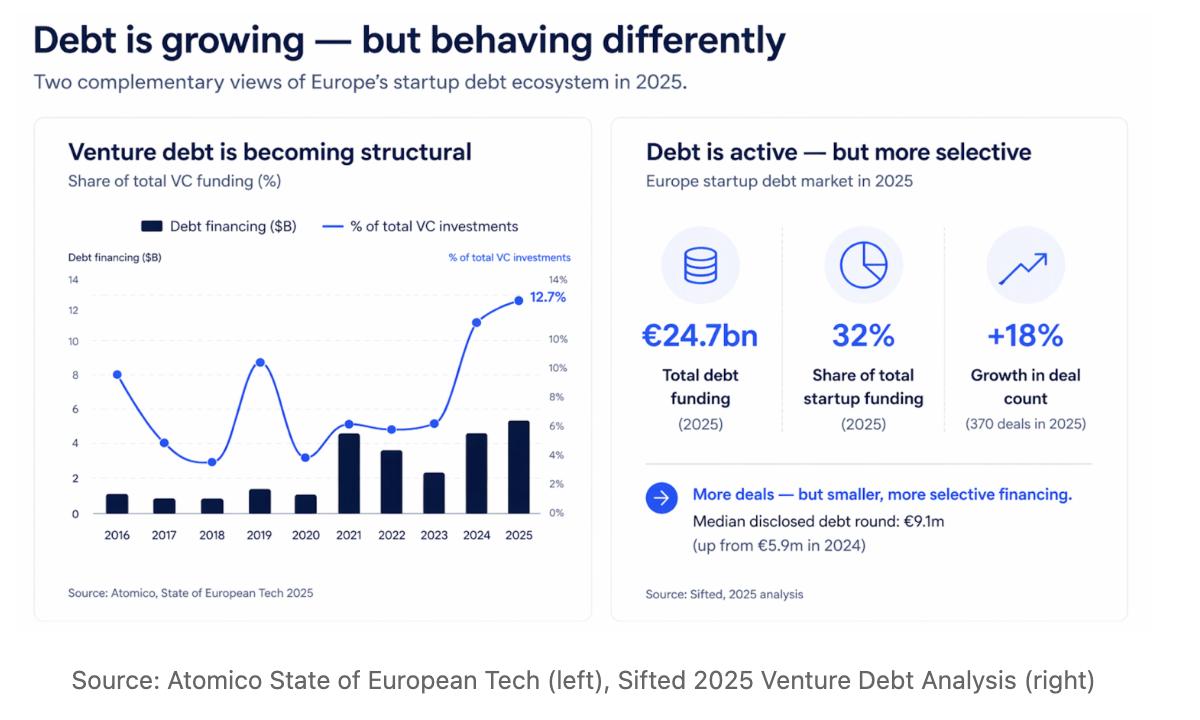
"The numbers reflect how fast this market has moved. According to Atomico's State of European Tech, European startups raised $5.6bn in pure venture debt in 2025 - a record, representing 12.7% of total VC funding. If you include the broader debt market, the picture is larger still: Sifted's full-year 2025 data puts total debt funding to European startups at €24.7bn, representing 32% of total startup funding, with deal count up 18% to 370 transactions. The underlying debt market is bigger, more active, and more accessible than it has ever been. That is not a problem in itself. Normalisation is exactly when discipline tends to slip.
"It's important to highlight that equity and debt are not interchangeable. Equity is for figuring things out - it funds the period where outcomes are uncertain and is designed to absorb that uncertainty. Debt is for doing more of what already works. You should not take debt to fund R&D, because the outcome is uncertain and debt has to be repaid regardless. You take debt once you have a product that is picking up, and you use it to scale that product. If you put 1 in and get 3 out, that is when debt makes sense.
Essentially, debt is for scaling certainty, not funding discovery.
"There is a spectrum of instruments between those two goal posts. Convertible debt sits in the middle between equity and debt - it is not as strict as traditional bank debt, but it is not equity either. At the other end from equity sits straight amortising debt from traditional bank (typically their Innovation teams): cheaper, with repayments starting from day one or about, and little flexibility if the business doesn't develop as planned.
"In practice that line gets crossed frequently. A company we worked with had taken on debt before their revenue was consistently predictable. The problem was structural - they had used scaling funding to fund research and day-to-day operations. This made the numbers look far worse than they were and the next fundraise considerably harder to run. That kind of damage is avoidable at the time of structuring the financing, and correctable if caught early - but gets harder to fix as time goes by once the financing is already in place.
"The trap is specific if you take too much debt, too early and revenue does not ramp fast enough - you face repayments you cannot absorb. Traditional banks typically cap debt at around one third of the equity raised for exactly this reason - the discipline is structural, not optional.
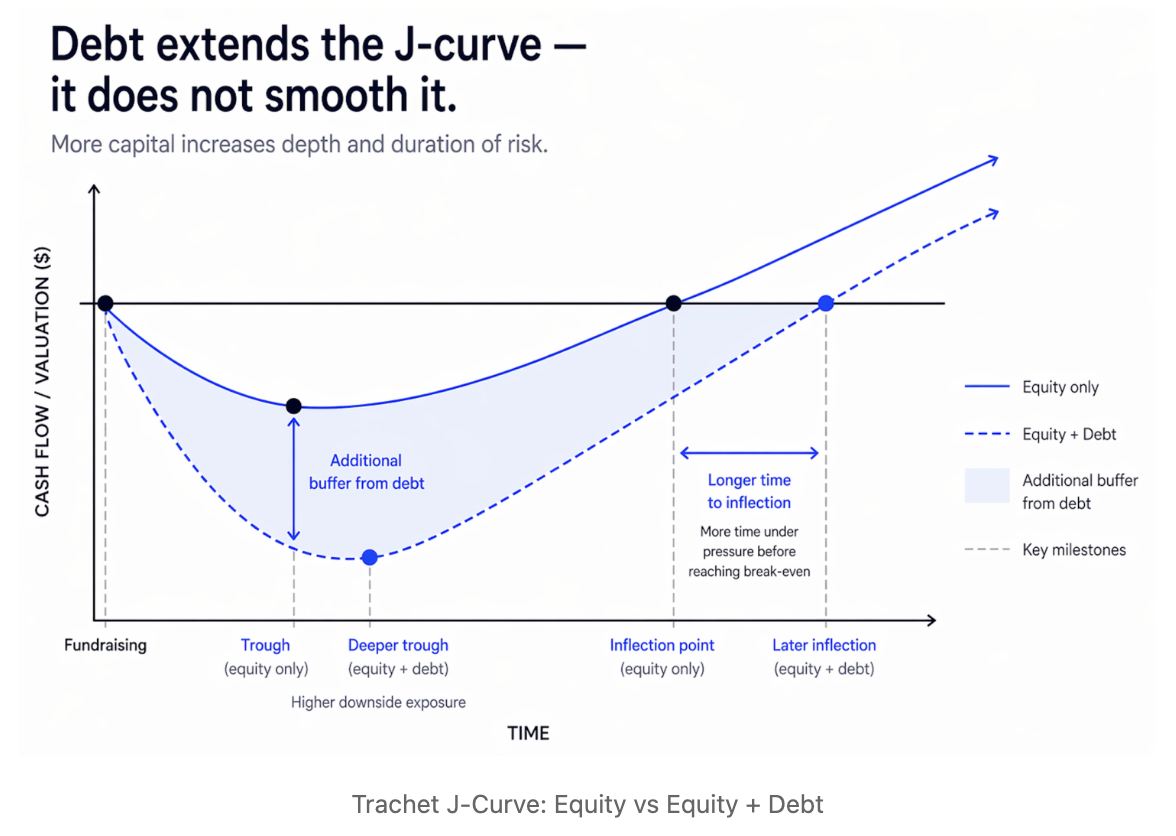
The other thing which we see is consistently misinterpreted is what debt does to the shape of the journey. Most founders are familiar with the J-curve - the period of investment and deepening losses before a business reaches its inflection point. Equity is raised to finance that downward part of the curve. Introducing debt changes the shape of the curve in a way that is not visible at close. Debt can give you more padding at the bottom, making the curve deeper. But it also makes it wider. Deeper, because you have more money to "dig through" the trough. Wider, because it gives you more time to your inflection point extends. You are not simply given more room. You are asked to carry more through that room, for longer, while the repayment clock runs throughout.
We saw this with another company we worked with. They had layered a meaningful debt facility on top of their equity round - the dilution saving looked compelling. Twelve months later, growth was slightly below plan. Not dramatically - just slower than modelled. The repayments had not changed. The board conversations were no longer about the growth plan. It became about the repayment schedule. Options that would have been straightforward six months earlier were off the table because the structure had narrowed them.
More runway is not necessarily less risk. It can be more time under pressure.
In the deep dive below we map exactly what alternatives are available for diversified financing and what it means for the decisions founders need to make before committing to a structure."
Deep Dive - Structuring equity and "debt" in practice
Not all non-equity financing does the same job. Some instruments solve short-term liquidity. Others support scaling. Others sit somewhere between financing and execution.
The mistake founders make is to treat them as a single category — “alternatives to equity”. In practice, they need to be understood by function, maturity, and timing.
Short-term liquidity
Some tools are not designed to fund growth. They are there to manage timing.
Factoring allows a business to raise capital against issued invoices. For companies with contracted revenue and long payment cycles, it can unlock working capital without forcing a broader financing event. This should be a short-term solution to working capital droughts, and it becomes problematic as a mid- or long-term solution. A vicious circle can easily get a good company into difficult territory.
Short-term loans and working capital facilities serve a similar purpose. They bridge temporary cash gaps and smooth operational mismatches. T&Cs vary widely and should be considered very seriously Some of these solutions may be very short term, expensive and require personal guarantees, while others are structured as a mid-term flexibility at affordable prices such as Revolving Credit Line (or RCL).
These are tactical tools. They do not replace a financing strategy - but they are useful tools, usually later in the maturity of the company or when there's no other option available to go through an exceptional working capital stretch.
Venture debt
Venture debt is debt typically available earlier than other non-equity financing options. It bears interests that are higher than a typical loan, and an adapted repayment schedule with a few years grace period or even a "bullet" repayment at the end. It is a term loan: debt and not equity, and should be treated as such - ie to finance scaling and not research.
Venture debt may be "Convertible" - where the amount may be either repaid or converted into equity, at the option of the company or the debt provider (TBD based on the negotiation). The conversion means less pressure on the company as there is no risk of default if the company isn't in a position to repay upon the term of the loan. Such convertible structures tend to be most common when getting a financing from your historical investors, whereas new investors will usually not offer that option. Convertibles tend to be a "bridge to" next funding round or M&A.
In either types of Venture debt, some providers offer payment-in-kind (PIK) structures, where interest accrues rather than being paid monthly/quarterly. These can look attractive at signing, but the cost compounds quickly if repayment/conversion happens later than expected.
Used correctly, venture debt can extend runway towards an event (reaching a milestone, next funding round or an exit) while minimizing the dilution. Used poorly, it introduces fixed obligations that the business may not yet be able to support - thereby potentially severely limiting the options for the company as time gets closer to the term of the debt facility.
Traditional bank debt
Traditional bank debt, including facilities from innovation teams within high street banks, varies significantly by country. In some countries, such as France, it is relatively well developed and sits alongside an equity round - often at around 20% to 35% of the equity raised. In others, it is less accessible.
Used at the right time, for the right purpose, it can be a highly effective tool. It is typically cheaper than venture debt, but also less flexible, with repayments often starting immediately and "amortised" over the duration of the loan. This requires a higher level of revenue/cash visibility.
One of the risks is timing. Following a strong equity round, access to bank financing can increase quickly. That availability can make it tempting to take on more debt than the business can sustainably absorb.
The fact that capital is available does not mean it is appropriate. Ensure such debt is used for scaling and not research, and has enough buffer (timing as well as in the magnitude of successful delivery of the plan) to keep optionality for the company. As long as used wisely, it is a tool that is very efficient and viewed as good news by your investors who thereby benefit from a "leverage" on their investment in your company.
Public-linked capital
Public-linked funding is worth understanding as two distinct categories.
1. The first is EU-level supranational institutions - namely the EIB, EIC for startups financing - each of which plays a distinct role. The EIB cannot hold equity in private companies by statute, so it uses a warrant mechanism - some form of venture debt that is "quasi-equity" in practice. The EIC can offer grants, equity, or both, and these are separable - a company can receive one without the other.
The EIB alone holds a significant share of the European venture debt market. The institution offers more structured instruments that - sitting between debt and equity - are more expensive than a typical bank facility, but available in considerably larger amounts and with longer tenors, primarily for companies with heavy R&D programmes. Eligibility is specific throughout: minimum round sizes apply, as well as strict rules as to what can be covered or not in terms of R&D expenditure, and the process takes about 6 months.
The EIC is also more complex and likely lengthier than a typical investor, however just like the EIB they are best used at times when investors might need more reassurance to invest in the business - providing "credibility" - as well as non-dilutive grants.
Both of these institutions typically come during or shortly after an equity financing round - and best is to work with them during your financing round to ensure all the criteria are met and there's "enough space" left for them after the equity round to meet their minimum investment sizes.
The scale of this category has increased materially. As Sifted reported in April, nearly €80bn of public money has been announced or committed across European startup and VC programmes since 2025 - reinforcing the growing role of public-linked capital in the ecosystem. The specificities of the processes with these institutions (criteria, timing) are to be taken into account, and their investments are usually welcome by shareholders not only for the larger amounts and longer tenors, but also for the credibility they bring when associating with a company - which can help convincing new customers to trust your company.
2. The second category is national development banks and regional funds - such as Bpifrance, the British Business Bank, Cassa Depositi e Prestiti (CDP), or KfW - which operate with country-level mandates and are very important for founders to consider alongside EU-level programmes.
The companies that fit this profile best share one characteristic: there is real technology and/or industrial advancement, but scaling is still risky on top of being capital-intensive. In software, the most risky and expensive part tends to be in the research phase, however the scaling might present specific challenges that these institutions can support. In industrial deeptech, tooling, raw materials, and manufacturing risk mean the development phase requires substantial external capital even after the core innovation is de-risked.
These institutions can typically only follow or co-lead, and hence require you to structure the transaction with another investor before they can join.
Both categories tend to have specific support initiative for their portfolio companies, which can provide helpful support beyond the mere capital.
Commercial partnerships
The best money remains your customer’s money. Beyond typical revenue, it is worth exploring whether any financing can be envisaged with existing/potential customers - as it often is a great way to accelerate the go-to-market too.
Joint ventures, development agreements, and customer-funded work can bring in capital while reducing execution risk and validating demand.
These structures can accelerate development and reduce capital requirements, particularly in deeptech and industrial businesses. But they come with trade-offs - around exclusivity, IP, and long-term alignment. They are very strategic decisions, and can seriously damage the company's prospects if not structured adequately. However, done right, they can be both a source of funding as well as accelerating (or at least de-risking) your go-to-market.
When to raise: timing is everything
Most founders approach non-equity financing after closing their equity round. That is the wrong sequence. Agree with incoming investors upfront that debt or institutional financing will be part of the structure - ideally it appears in the business plan from the start. Then approach providers in parallel with the equity process.
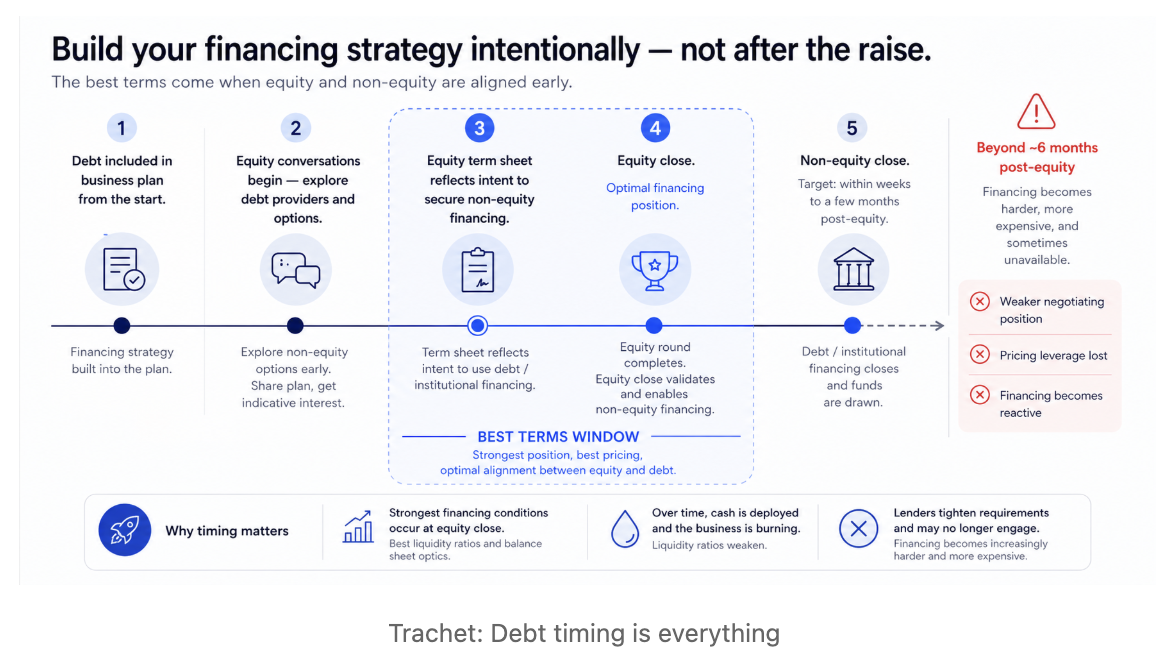
You will get the best terms immediately after raising equity. Lenders see a freshly closed round as validation and that pricing leverage does not last. Close non-equity financing within a few weeks to a few months of the equity close, and certainly within six months. Get a term sheet for your equity that acknowledges the planned financing, and close both in quick succession. The economics - and the optionality - are materially better.
Three principles cut through the noise.
Debt should fund scaling, not uncertainty. Over 80% of European venture debt by value flows to late and venture-growth stage companies. That reflects where the instrument genuinely fits - businesses with proven models, repeatable revenue, and capital needs tied to execution rather than discovery. If you are still figuring out what works, equity should lead. Are you scaling something proven, or still finding it?
Poorly timed debt concentrates risk in the downside. The sequence plays out the same way each time: debt too early, revenue slower than planned, repayments that cannot be absorbed, options that close when you need them most. The lesson holds regardless of instrument: debt does not create tolerance for uncertainty, it removes it. If revenue is six months behind plan, does your structure still hold?
Debt stretches the J-curve - it does not smooth it. More runway is not less risk. Debt adds buffer at the bottom of the curve but also makes it deeper and wider. You carry more weight for longer while the repayment clock runs throughout. If the path out is clear, the extension helps. If it is not, the exposure compounds. Is there a specific milestone this capital bridges you to - or is it buying time while uncertainty persists?
These three questions are the starting point - ideally next taken into a discussion with your Board with a list of the options available for your next financing round.
Trachet Deal Roundup
Agriodor raises €15m Series A to scale scent-based crop protection globally
We’re proud to have advised Agriodor, a French agtech company, on its €15m Series A, combining equity and debt to support the international rollout of its olfactory biocontrol platform.
The round was led by Crédit Mutuel Impact (Environmental and Solidarity Revolution Fund), with participation from Région Sud Investissement, CAAP CREATION (Crédit Agricole Alpes-Provence), Capagro, CapHorn, and SWEN Capital Partners.
Agriodor is tackling a system under pressure - where insecticide resistance is rising, biodiversity is declining, and traditional crop protection models are reaching their limits. Its technology uses natural plant scents to influence insect behaviour, offering a residue-free alternative to synthetic pesticides, with development cycles significantly faster and more cost-efficient than conventional solutions.
The funding will support continued R&D as well as expansion across Europe, North America and Latin America.
Read more:
→ EU Startups | Scents versus insects: Agriodor raises €15 million to protect crops with olfactory biocontrol by Rahul Raj
→ Les Echos | French Tech : Agriodor mise sur les odeurs pour protéger les cultures by Camille Wong
News Roundup
Your go-to monthly roundup of Trachet in the news, key deals in the UK/EU startup arena, and emerging trends to watch.
Trachet in the news:
→ Buyout Funds Close In on Blue-Chip Takeovers as Listings Lose Luster - Bloomberg
Trachet was featured in Bloomberg’s Going Private newsletter commenting on the rise of blue-chip take-private deals, with Claire Trachet arguing that private ownership is becoming a serious route for building large companies. She noted that PE-backed ownership can give businesses more breathing room, longer-term alignment and protection from volatile public markets that do not always reward long-term fundamentals.
→ Lovable is promising staff a 10% raise on their work anniversary. Here’s why it won’t catch on - Sifted
Trachet was featured in Sifted commenting on Lovable’s pledge to give employees a 10% annual pay rise, with Claire Trachet warning that while the policy is generous, fixed commitments can become difficult to sustain as companies scale or market conditions shift. She pointed to Covid-era policies like unlimited holiday as a reminder that startup perks can be rolled back when growth realities change.
→ What founders need to know before resetting their valuation in 2026 - Tech Funding News
Trachet was featured in Tech Funding News commenting on the rise of down rounds in Europe, with Claire Trachet arguing that founders should look beyond the pitch deck and reassess the full fundraising strategy before accepting a valuation reset. She highlighted that alternative structures such as bridges or convertibles can help preserve optionality, but only when trust with the board has been built early, and warned that punitive terms can sometimes cost founders more than a cleaner, modest down round.
→ Elon Musk shifts SpaceX’s goals ahead of IPO - New York Times
The New York Times reports that Elon Musk is reshaping SpaceX’s strategic priorities ahead of its anticipated IPO - a move that would be unusual for most companies at this stage. Rather than presenting a stable, focused narrative, SpaceX is expanding aggressively into AI and broader technology ambitions alongside its core space business.
The signal is less about the IPO itself and more about positioning. SpaceX is not pitching a mature, predictable business, but a long-term platform spanning space, infrastructure and AI. That creates upside - but also shifts the investment case from execution to vision, with investors effectively underwriting a broader, less defined strategy.
→ Europe considers loosening merger rules to build global champions – Financial Times
The Financial Times reports that European policymakers are exploring ways to relax merger rules in an effort to create larger, globally competitive companies.
The underlying issue is structural. Europe has depth in early-stage innovation but struggles to scale companies into global leaders. Adjusting competition frameworks is an attempt to address that gap - moving from protecting markets to enabling scale. The risk is that policy alone cannot compensate for deeper issues around capital, execution and market fragmentation.
→ Bill Ackman’s ‘masterstroke’ if he can pull off Universal deal - The Times
The Times reports that Bill Ackman has launched a €56bn bid for Universal Music Group, aiming to merge it with his SPAC and relist it in New York to unlock value after a period of share price underperformance. The deal hinges on securing support from the Bolloré Group, without which the transaction cannot proceed.
The structure is ambitious - relying heavily on debt and forward-looking valuation assumptions - prompting some analysts to view it as closer to a “stock pitch” than a fully grounded offer. The signal is broader: in a more constrained market, financial engineering alone is no longer sufficient to bridge the gap between valuation and fundamentals.
→ Technology M&A’s record run ends in 20% slump - Bloomberg
Bloomberg reports that global technology M&A is down around 20% year-on-year in early 2026, despite overall deal activity increasing.
The slowdown is being driven by falling software valuations and rising uncertainty around AI disruption, with advances from players like Anthropic prompting investors to reassess the durability of traditional SaaS models. Private equity is particularly exposed, holding assets acquired at 2021 peak valuations and now facing more complex exit conditions.
The reset highlights a shift in the market: valuation compression is no longer cyclical, but increasingly structural, as technology risk is repriced in real time.
→ US investors prefer Europemaxxing to Europebashing - Financial Times
The Financial Times highlights a growing trend of US investors “Europemaxxing” - deploying capital into European tech, particularly AI, where talent is strong and valuations remain more attractive than in Silicon Valley. Around 73% of large European AI funding rounds are now backed by US capital.
While this influx supports growth, it reinforces a structural imbalance: Europe continues to generate innovation, but risks exporting value through talent, acquisitions and listings. The implication is clear - capital alone is not the constraint. Retaining strategic control will require deeper growth funding, stronger domestic ecosystems, and a shift in ambition around building global champions.
→ The 20 companies that landed Europe’s largest equity deals ever - Sifted
Sifted reports that Europe is no longer capital-constrained, but increasingly outcome-constrained. Mega-rounds - particularly in AI - are becoming more frequent, but examples such as Northvolt show that access to large amounts of capital does not guarantee durable success.
Larger raises increase expectations, accelerate burn, and reduce flexibility if conditions shift. At the same time, capital is concentrating around a small number of companies, often backed by the same global investors. The result is a more polarised market: more capital available, but with higher execution risk and less room for error.
→ Quantum and AI drive UK startup funding to £7.8bn – City AM
City AM reports that UK startup funding has reached £7.8bn in 2026, driven largely by continued investment into AI and emerging technologies such as quantum.
The signal is one of concentration rather than breadth. Capital continues to flow into sectors with clear long-term potential and strategic relevance, while other areas remain more constrained. The dynamic reinforces a broader trend: funding is available, but increasingly selective - with scale, technical depth and strategic positioning determining where capital actually lands.
We’re keen to hear about the key challenges (or opportunities!) shaping your company’s objectives in 2026. Email me at claire@trachet.co for more information on topics you'd like to see discussed in future issues of What’s the deal?
