
What's the deal? The Tech M&A & Fundraising Newsletter - AI Strategy: Buy or Build?
AI Strategy: Buy or Build?
AI is starting to change how founders raise, spend and justify capital.
For the past two years, much of the conversation on AI has focused on adoption: which tools to use, which models to integrate, and where automation can improve productivity. But for Series A to C companies, the more important question is now becoming whether AI strengthens the investment case, weakens defensibility, changes the hiring plan, or creates a capability that should be built, bought, partnered for or acquired.
Welcome to What’s the Deal? - your monthly deep dive into the strategic forces shaping the tech investment landscape. This June edition focuses on AI strategy: not as a question of adoption, but as a question of capital allocation, fundraising readiness and M&A defensibility.
A note from the Editor - CEO Claire Trachet
"Over the past two years, we have been exploring AI strategy with founders through questions of productivity, product development, hiring and partnerships through the lens of fundraising, M&A and finance strategy.
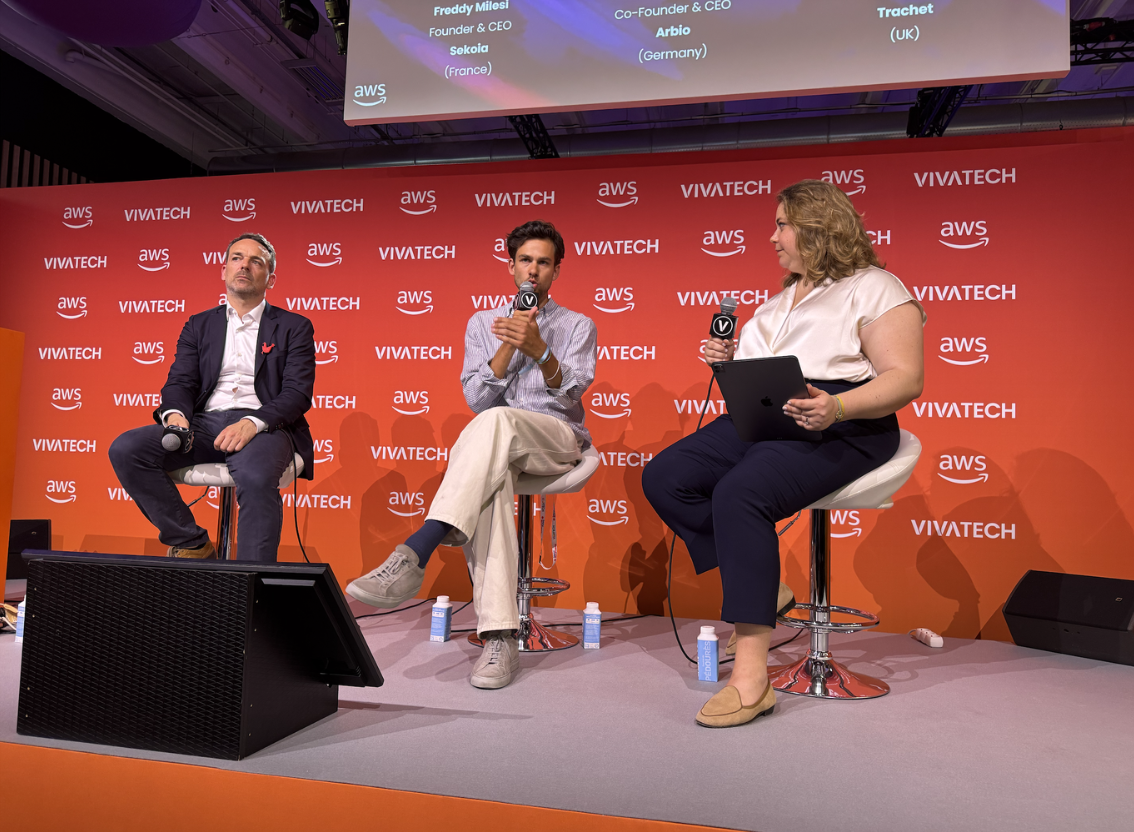
"Last week, I had the pleasure of moderating a VivaTech panel on this topic with Constantin Schröder, Co-Founder and CEO of Arbio, and Freddy Milesi, Founder and CEO of Sekoia. The discussion focused on one of the most important strategic questions for high-growth companies today: should they buy or build their AI capabilities?
"The timing is really interesting - there are so many more tools available, more proven use cases, stronger APIs and a clearer sense of where AI can create value. At the same time, the technology is moving so quickly that a capability built internally today may be matched by an external tool before it is fully deployed. That is what makes the question difficult.
"A company can spend six months and meaningful capital building something that quickly becomes available off the shelf. It can buy a tool to move faster, only to find later that the workflow, data or margin has moved too far outside the business. Buy or build is no longer mainly a productivity question. It is becoming a capital allocation, defensibility and enterprise value question.
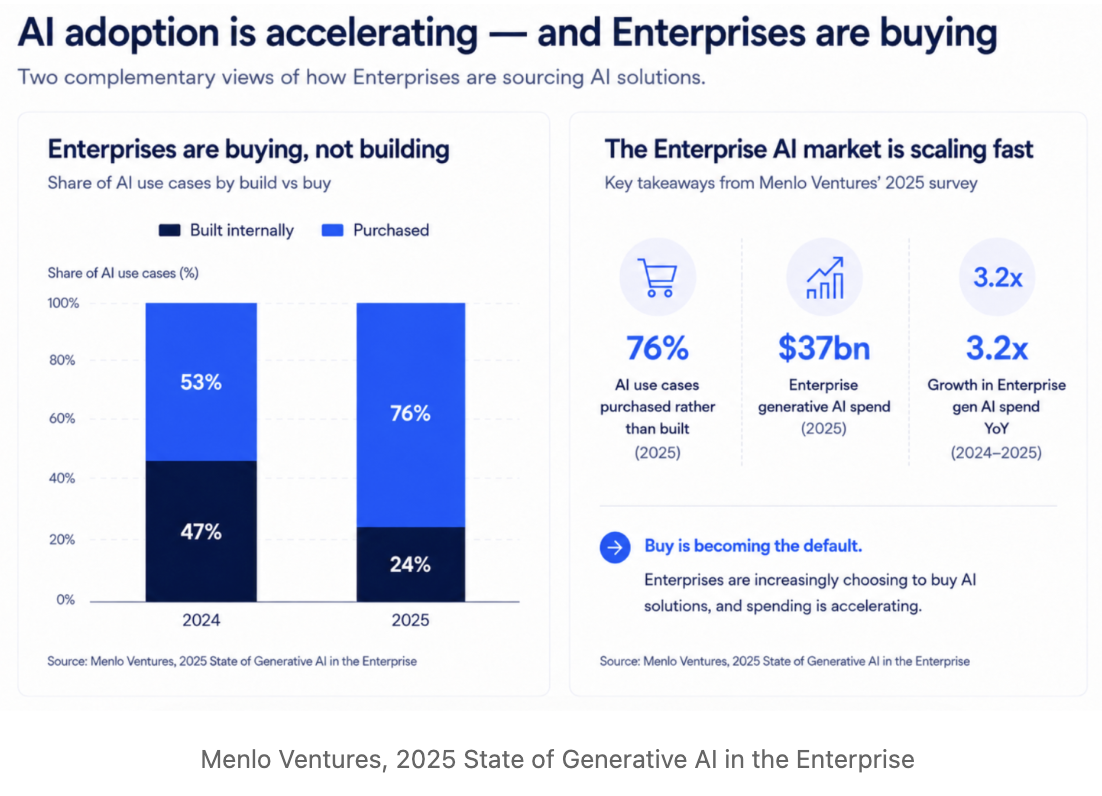
"The market is clearly moving towards buying. Menlo Ventures found that 76% of enterprise generative AI use cases are now purchased rather than built internally, compared with 53% in 2024. Buying is often faster, cheaper and easier to justify than building from scratch.
"But buying becoming the default does not make it the right answer in every case.
"That was clear from the VivaTech discussion. Arbio is a useful example because its M&A strategy is not about acquiring AI capability. It is about acquiring fragmented operators in the property management market, then using AI to unlock value from the data, customer relationships and workflows those operators already hold. The acquisition brings market position and operational depth. AI becomes the layer that makes those assets more scalable. As Constantin put it:
“External tools are R&D, not strategy.”
"Sekoia offers a different lesson. In cybersecurity, where trust, traceability and accountability are core to the product, the company has taken a much more deliberate build approach for its AI intelligence layer. Freddy explained that some planned acquisitions were halted because internal AI development became faster and more valuable than buying and integrating external capabilities. In that case, AI did not create an acquisition rationale. It removed one. His broader point was equally important:
“AI transformation doesn’t start with agents. It starts with clean data and clear processes.”
"Many founders focus on the visible layer of AI - copilots, agents and automation. However he highlighted the harder work sits underneath, in the data.
"The same logic is visible in larger market examples. Databricks acquired MosaicML because it wanted to own a strategic layer: helping enterprise customers train and secure generative AI models on their proprietary data. Snowflake, by contrast, partnered with Anthropic because it did not need to build a frontier model to bring AI into its data cloud. KPMG is reportedly exploring partnerships and investments in AI companies that could strengthen, or eventually disrupt, its own workflows. The reported US$60bn acquisition of Anysphere, the company behind Cursor, points in the same direction: the value is not simply in the model, but in owning the workflow where developers increasingly build software. These examples matter because they show that there is no single answer.
"Different answers, but the same underlying discipline: understanding where value sits.
"This is becoming more visible in fundraising and M&A discussions. Investors want to understand what a company owns, what depends on third parties and where future margin will sit. Buyers are asking similar questions. Freddy made the point that some investors are now using technical teams to test how easily products can be recreated with AI-assisted development tools. If the apparent advantage can be rebuilt quickly, the question changes.
"The issue is no longer just whether the product works, it is also about what cannot be replicated. For founders, that means the AI decision has to start with a clear view of the moat: data, workflow, customer relationship, process intelligence, trust, distribution or operational expertise. Only then can they decide what to buy, what to build, where to partner and when acquisition becomes the right answer.
"In the deep dive below, we explore a practical framework for making exactly those decisions.
Deep Dive - How to build an AI decision framework
The "buy-or-build" question is too narrow.
For most founders, the real task is to create a consistent way of deciding where AI belongs in the business, how much capital to allocate to it, and when a decision should be revisited.
That framework does not need to be complicated. But it does need to be explicit. A founder should be able to explain to the Board, investors or a potential acquirer why one capability was bought, another was built, another was partnered for and another may need to be acquired later.
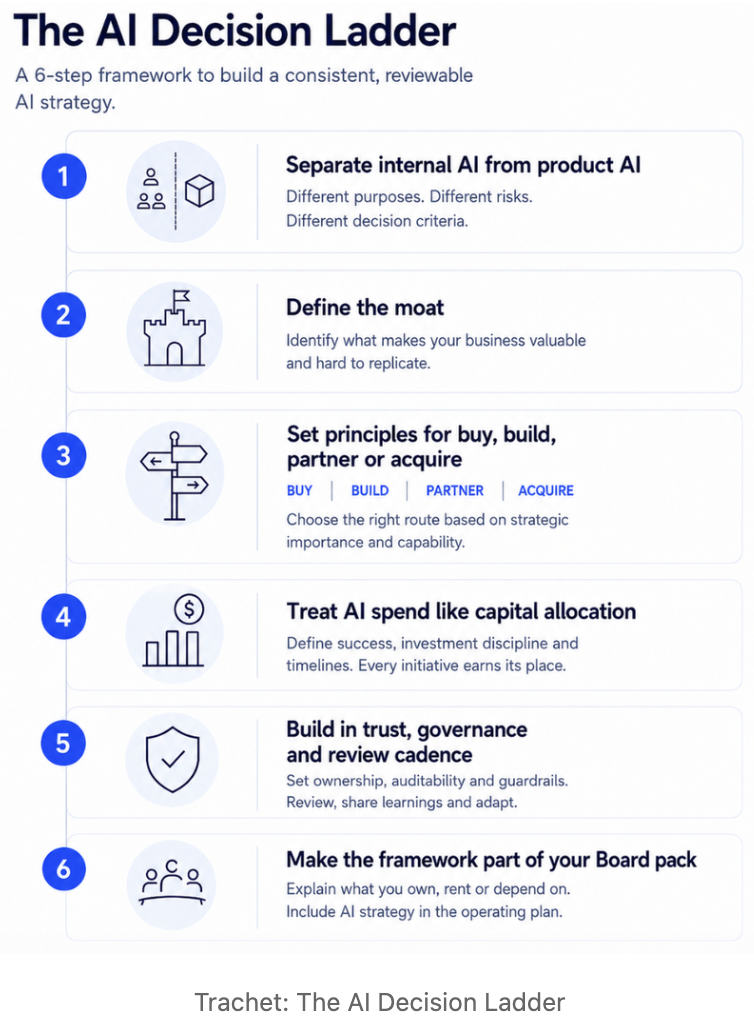
The goal is not to find one universal AI strategy. The goal is to build a decision-making process that is clear, consistent and can be iteratively improved.
1. Separate internal AI from product AI
Start by dividing AI initiatives into two categories.
Internal or operational AI improves how the company works. This includes AI used in sales, marketing, finance, HR, customer support, research, reporting or internal coding. These decisions are usually about productivity, cost, speed and workforce planning.
Product or client-facing AI changes what the customer experiences or pays for. This includes AI embedded in the core product, decision-making engine, customer workflow, proprietary intelligence layer or revenue-generating capability. These decisions are usually about ownership, defensibility, trust and future enterprise value.
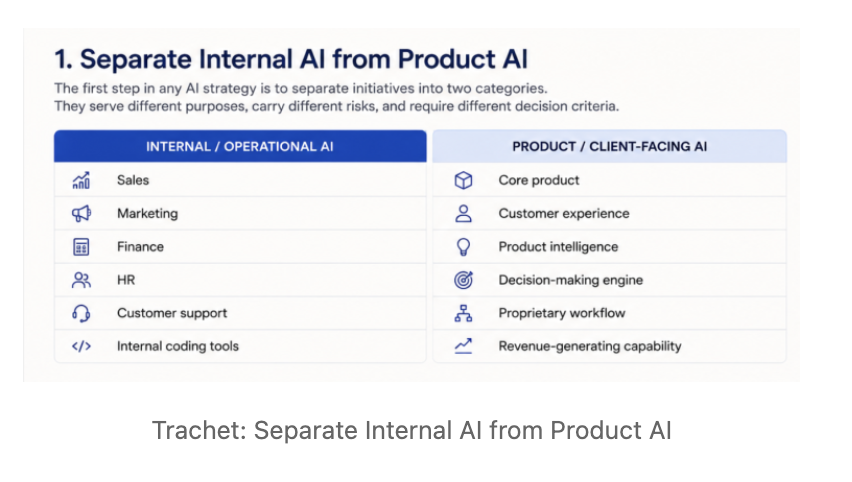
This distinction matters because the decision criteria are different. Internal AI can often be bought first and reviewed later. Product AI requires more scrutiny because it may sit close to the company’s moat.
Key questions:
Is this improving our internal operating model or the customer proposition?
Would customers notice if this capability disappeared?
Does this influence revenue, margin, retention or pricing power?
Is this something investors or acquirers would later expect us to own?
Recommendation: Create a simple AI register split between internal AI and product AI. Do not judge both categories using the same criteria. For internal AI, decide where the company is willing to spend money to move faster. For product AI, be much clearer on the trade-off between speed and proprietary control.
2. Define the moat before choosing the route
The next step is to define what actually makes your company valuable.
A moat might sit in proprietary data, workflow ownership, customer relationships, domain expertise, distribution, trust, compliance, process intelligence or speed of execution. The point is to have clarity on what matters most for this specific business.
This should come before any decision about buying, building, partnering or acquiring. Without clarity on the moat, AI decisions become reactive. One team buys a tool because it is available. Another builds something because it feels strategic. Another enters a partnership because it is fast. None of those decisions may be wrong individually, but together they can make the company harder to explain.
Key questions:
What makes us win against the competition?
What do we do that is difficult for others to replicate?
What data, workflows or customer relationships are genuinely proprietary?
Which part of the value chain do we need to control?
If we were raising or selling the company, what would we want investors or buyers to value?
Recommendation: Write the moat down. It does not need to be long, but it does need to be explicit. Challenge it with the executive team and then validate it with the Board as part of the wider AI strategy. This is often where advisors and non-executive directors can be useful: not because they know the business better than management, but because they can test whether the company’s assumptions are clear enough to hold up externally.
3. Set principles for buy, build, partner or acquire
Once the moat is clear, founders can set principles for each route.
Buying is usually appropriate where the capability is useful but not strategic. It is the fastest route to learning and often the right answer for internal productivity tools or mature SaaS categories.
Building is appropriate where the capability sits close to the moat, uses proprietary data, improves the core product or creates a capability that investors and acquirers will later treat as central to the business.
Partnering is useful when the capability matters, but the market is moving too quickly to justify building alone. It can give a company speed, expertise or distribution without requiring full ownership immediately.
Acquisition becomes relevant when the technology, team, data or workflow has become too strategic to leave outside the business.
Key questions:
Is this capability useful, or is it strategic?
Is speed more important than ownership right now? And for how long?
Do we have the capability to build it in-house at an efficient cost?
Would dependency on this provider become a problem if usage scaled?
Could this partner become an acquisition target?
Does building this improve enterprise value, or just absorb capital?
Recommendation: Every major AI decision should explicitly consider all four routes: buy, build, partner and acquire. The chosen route should be justified against the company’s moat, not just against short-term convenience.
4. Treat AI spend like capital allocation
AI now has to compete for capital like every other part of the business.
For VC-backed companies, agents, tokens, tools, infrastructure and specialist hires need to earn their place in the operating plan. They should be treated with the same discipline as headcount.
The question is not whether AI is useful. The question is where it creates the highest return.
That return may be productivity, lower cost, faster execution, margin improvement, customer retention, increased upsell or cross-sell, better product adoption, new revenue or stronger strategic control. But it needs to be defined upfront.
Key questions:
What does success look like after three, six or twelve months?
Which metric tells us this is working?
What cost are we willing to accept before value is proven?
Does this reduce future headcount needs, improve existing productivity or create new revenue?
What would make us stop funding it?
Recommendation: Every meaningful AI initiative should have an owner, a budget, a success metric and a review date before capital is committed. If it would not pass the test for a hire or a strategic project, it should not pass the test simply because it is AI.
5. Build in trust, governance and review cadence
If you operate in high-stakes sectors, such as cybersecurity or professional services, trust is a critical part of the product. In these instances, it is not enough for AI to be fast or impressive. It has to be explainable, auditable and replicable. Founders need to know whether outputs can be reviewed, challenged and traced, especially where AI touches customers, regulated workflows, critical decisions or sensitive data.
Governance also means deciding who makes AI decisions. If every team chooses its own tools without shared principles, the company ends up with duplicated spend, unmanaged risk and a fragmented strategy. A big part of governance is also deciding who is ultimately accountable for that AI, from planification to maintenance, as well as the output from the AI.
Last but not least, the review process matters just as much as the original decision. AI costs, capabilities and competitive dynamics change quickly. A buy decision today may need to become a build decision in twelve months. A partner may become an acquisition target. A build project may need to be stopped.
Key questions:
What does success look like after three, six or twelve months?
What metric tells us this is working?
Who owns the decision internally?
Who is accountable for the AI output?
Can we audit the output, cost and risk?
What would trigger a change from buy to build, partner to acquire, or build to stop?
Recommendation: Set a regular AI review cadence, which can vary topic by topic - but it should be revisited at the very least every 12 months. Use it to assess what worked, what failed, what should be stopped and what needs to change. The best companies will not simply adopt AI faster; they will learn more and faster - compounding their progress.
6. Make the framework part of your Board pack (hence viewable by potential acquirers)
This is where AI strategy becomes part of the fundraising and M&A story.
A company does not need to build everything in-house to be valuable. But it does need a clear logic for what it owns, what it rents, what it depends on and what it may need to control later.
Investors and acquirers will increasingly ask where the AI capability sits, whether it is defensible, whether it relies on third parties, whether the data is proprietary and whether the workflow is owned by the company or by someone else.
A consistent framework makes those answers easier. It shows that AI is not a scattered set of experiments, but part of the company’s operating model, capital allocation plan and defensibility story. Independent of the answers, clarity adds a lot of value in and of itself.
Key questions:
Can we explain our AI strategy in one page?
Do we know which AI capabilities we own, rent or depend on?
Would an investor understand why we made each decision?
Would an acquirer see this as strategic value or integration risk?
Recommendation: Include AI strategy in the Board pack and fundraising narrative, not as a technology appendix, but as part of the strategic plan.
News Roundup
Your go-to monthly roundup of Trachet in the news, key deals in the UK/EU startup arena, and emerging trends to watch.
Trachet in the news:
→ London has a serious underpricing problem, says Trachet CEO - CNBC
→ A US firm is eyeing easyJet — but would a takeover be allowed? - The Times
Robert Lea reported that US investment firm Castlelake’s interest in easyJet has reignited concerns over foreign buyers targeting undervalued UK-listed companies. The piece explored whether a takeover could clear EU airline ownership rules, while also placing easyJet in the wider context of overseas investors circling London-listed businesses trading at a discount.
Trachet contributed by framing this as part of a broader UK markets problem. Claire Trachet argued that low FTSE valuations are making British companies more visible to overseas buyers, and that while take-privates are not inherently negative, the combination of rising foreign bids and too few new listings is becoming unsustainable.
What we’ve been reading:
→ 10 years after Brexit, Keir Starmer’s resignation highlights Britain’s deeper issues - NBC News
NBC News argues that Keir Starmer’s resignation, 10 years after the Brexit vote, reflects a deeper pattern of political and economic instability in the UK rather than a single leadership failure. The country is now set for its seventh prime minister in a decade, after years of shocks including austerity, Brexit, Covid, the war in Ukraine, inflation, weak wage growth and pressure on public services. The article frames Andy Burnham’s likely succession as an attempt to restore confidence, but warns that he would inherit the same structural constraints: low growth, strained public finances, fragile trust in institutions and a more fragmented electorate. The broader signal is that UK political volatility is now becoming an economic risk in itself, with businesses, investors and households operating in an environment where long-term policy direction feels increasingly uncertain.
→ More VC mergers are coming, says P101 founder - Sifted
Sifted reports that Milan-based VC P101 has acquired fellow Italian seed investor PranaVentures, creating a combined platform with more than €600m in assets under management. P101 founder Andrea Di Camillo says the logic mirrors the consolidation already happening across startup portfolios: firms need greater critical mass, broader market access and stronger platforms to compete. The signal is that VC itself is starting to behave more like the asset management industry. In a tougher fundraising environment, smaller managers may struggle to scale organically, while larger platforms can offer LPs more products, deeper capabilities and more consistent deployment. European VC consolidation still remains rare, but P101’s view is that more fund manager M&A is likely over the next 12-18 months.
→ OpenAI Considers Delaying IPO To 2027 After SpaceX’s Rocky Debut, Report Says - Forbes
Forbes reports that OpenAI is considering delaying its IPO until 2027, after advisers warned that volatile public tech markets may not support the $1tn valuation Sam Altman is seeking. The hesitation follows SpaceX’s record-breaking but rocky debut, with its shares falling sharply after an initial surge, and comes amid wider investor concern over whether AI companies can justify extreme valuations while still absorbing enormous compute and infrastructure costs. The signal is that the AI IPO window is not simply about demand for exposure to frontier companies. Public investors are becoming more disciplined on profitability, capital intensity and valuation, forcing even the most prominent AI names to choose between speed, price and market credibility.
→ Exclusive: France seeks to block UK role in €5bn EU Scaleup fund - Sifted
Sifted reports that France is seeking to block UK participation in the EU’s €5bn Scaleup Europe Fund, raising doubts over whether British startups will be eligible for one of the bloc’s most ambitious late-stage investment vehicles. The fund, managed by EQT, is designed to address Europe’s shortage of growth capital in strategically important sectors such as AI, defence and semiconductors. The dispute exposes a deeper tension in European tech policy: the UK has one of the continent’s strongest startup pipelines, but post-Brexit politics and sovereignty concerns are making capital coordination harder. The signal for founders is uncomfortable. Europe wants to build global tech champions, but fragmented rules and national interests may still limit the scale of capital available to its best companies.
→ Tate & Lyle agrees £2.7bn takeover by US rival in new blow to London market - The Guardian
The Guardian reports that Tate & Lyle has agreed to a £2.7bn takeover by US rival Ingredion, valuing the FTSE 250 ingredients group at 615p a share - roughly 60% above its pre-speculation price. The deal could lead to nearly 500 job losses globally and marks another symbolic blow to the London market, with one of the UK’s oldest listed companies set to leave public markets after years of share price pressure. The broader signal is familiar: depressed UK valuations continue to make London-listed companies attractive to overseas buyers, while the public market loses another longstanding name.
→ President Emmanuel Macron announces €93bn in ‘Choose France’ investments - Euronews
Euronews reports that Emmanuel Macron has announced a record €93bn of investment pledges under the “Choose France” programme, far exceeding last year’s €20bn and the €87bn raised across the previous eight editions combined. AI and data centres sit at the centre of the announcement, with SoftBank pledging €45bn by 2031 for AI infrastructure in northern France, alongside commitments from Brookfield, Ardian/Verne, Salesforce, Amazon and Foxconn. France is using cheap, low-carbon nuclear power and foreign capital momentum to position itself as Europe’s AI and computing hub. The question is whether these headline commitments can translate into durable industrial capacity, rather than masking weaker corporate investment elsewhere.
→ German VC coalition calls for institutional capital shift to power next-gen startups - Tech.eu
Tech.eu reports that 24 German VC firms have launched the German Venture and Growth Forum, alongside a new German Venture & Growth Playbook, to push more institutional capital into German and European growth companies. The argument is not that Germany lacks talent, industrial depth or technical ambition, but that it lacks growth capital. With German institutional investors managing around €2.8tn, even small allocation shifts could unlock an estimated €15bn a year for startups and scaleups. The forum is framing VC as both a returns opportunity and a competitiveness issue: without deeper domestic growth capital, Europe risks building promising companies in AI, robotics, quantum, fusion, defence and space - only to see the value captured elsewhere.
→ Aria chief: ‘We must ride the AI wave or get smashed by it’ - The Times
The Times reports that Kathleen Fisher, the new chief of Aria, has warned UK organisations that they must embrace AI or risk being overwhelmed by it, comparing the shift to a “tidal wave” that companies either learn to ride or get “smashed” by. Her argument is not simply about automation, but adoption: she says companies should use AI to empower people rather than replace them, warning that a replacement-first approach could provoke serious social backlash. Fisher also identifies risk aversion as one of the UK’s deeper weaknesses, arguing that Britain needs to move faster, tolerate failure and build critical AI infrastructure and technologies rather than only chasing the next trillion-dollar company.
We’re keen to hear about the key challenges (or opportunities!) shaping your company’s objectives in 2026. Email me at claire@trachet.co for more information on topics you'd like to see discussed in future issues of What’s the deal?
