
What's the deal? The Tech M&A & Fundraising Newsletter - The Layered Dataroom “Blueprint”
The Layered Dataroom “Blueprint”
AI valuations reach new heights as investors warn of late-cycle signals; liquidity tightens, exits remain weak, and capital accelerates its concentration at the top. Founders face a shifting landscape where clarity, optionality, and discipline are their strongest leverage.
Welcome to What’s the Deal? - your monthly deep dive into the strategic currents defining the tech investment landscape.
This edition focuses on the Layered Dataroom "Blueprint" and explores how founders can prepare for a market cycle increasingly shaped by AI’s capital concentration and slower fundraising dynamics by building investor confidence and managing liquidity risks.
A note from the Editor - CEO Claire Trachet
“This month we attended the Sifted Summit, one of Europe’s key gatherings for founders and investors - and in my opinion, the conference offering the highest concentration of exceptional entrepreneurs and ecosystem players. Amongst a busy meetings schedule, a few conversations really captured the tension shaping Europe’s startup landscape - ambition, capital, and control. These are the discussions I thought it was important to share in this edition of What’s the Deal?
“A key takeaway came from Eric Schmidt, former CEO of Google, who tackled what he called Europe’s ‘scale ambition problem’. His message was simple: European founders sell too early. ‘Please don’t sell for $100 million. Aim for $100 billion.’ He’s right - we still think too locally, too short-term. The challenge for Europe isn’t a lack of innovation, it’s a lack of patience.
“Alexandra Depledge, an entrepreneurship advisor to the UK government, warned that Britain risks becoming a ‘research and development department for the US’. Too much of our talent and IP still heads across the Atlantic in search of deeper capital markets and faster exits. Her mission - one I strongly agree with - is to create conditions that make it viable for founders to stay, scale, and list here.
“What wasn’t said on stage, but was present in every private conversation, was the growing concern about an AI bubble.
“Investment in artificial intelligence has reached nearly $200 billion this year, with over 40% of global VC funding going to just ten companies such as OpenAI, Anthropic, and Databricks. Capital is being pulled to the top, distorting the flow of funding and leaving less oxygen for early and mid-stage founders.
“Data from HSBC and Dealroom shows that UK start-ups raised $9 billion in Q3 - the second-highest third quarter on record - as investors deployed what remained of their dry powder. Yet the UK, which typically accounts for half of Europe’s VC fundraising, has raised just £7 billion so far this year - down nearly 40% from 2024, according to PitchBook.
“The issue is structural. Exits and IPOs remain scarce, liquidity isn’t recycling, and fund managers are taking longer to close new funds. Too much capital is tied up in late-stage AI companies at valuations that will be hard to sustain if markets cool. If those bets don’t pay off, capital won’t flow back into the ecosystem - and raising in 2026 will be harder.
“We’re not in a full-blown bubble yet, but the signals are familiar: valuations rising faster than liquidity, investor scrutiny tightening, and capital consolidating.
For founders, the takeaway is clear:
If you can raise, do it earlier - and raise a little more. As I told @Sifted’s Kai Nicol Schwarz earlier this week, target 24 to 30 months of runway and focus on the quality of your revenue and contracts, not headline growth.
Moat over model. If you’re AI-native, prove data defensibility and infrastructure flexibility. If you’re not, show how AI improves your margins or efficiency.
Plan B early. Explore structured capital or strategic M&A now - the best outcomes are pre-planned, not reactive.
"Europe’s next generation of champions will be the ones who stay disciplined on runway, optionality, and execution - resilient through the toughest times with the consistent support of their historical investors (!) . The boom may not be over, but the cycle is shifting - and clarity, not hype, will define who comes out stronger.
“One of the best ways to build that clarity is through how you run your process. Whether you’re fundraising or preparing for M&A, your data room is the most powerful signal of your company’s discipline. It’s where investors see how you think - and where trust is either built or lost.
“In this month’s Deep Dive, we unpack what we call the Layered Data Room "Blueprint" - a layered approach to disclosing information dynamically to prospective investors, helping founders lead the dance between controlling disclosure, maintaining leverage, and building trust as they secure funding through a more selective market.”
The Layered Dataroom “Blueprint”
By Series A, the data room stops being an afterthought. From my experience advising scaleups through both fundraising and M&A, I’ve seen how much strategic management of the data room can support the transaction’s momentum. Investors don’t just look at what’s inside - they judge how the room is built and managed.
A data room is the backbone of the Due Diligence your company goes through in these processes. Every piece of information shared prior to the Term Sheet (verbally or in writing) gets checked, and every contract reviewed. When stepping into a process, our framework ensures we cross-checks the basics first - payroll against employment contracts, board minutes, captable history and waterfall forecasts,... . To this date, we’ve always identified points, even in companies that have raised before, which we could preemptively align before the process so they don’t become a topic of the Due Diligence (or a surprise red flag!).
Handled well, the dataroom shows discipline and gives investors confidence that the company is well-run, the management team functioning well. Handled poorly, you’ll end up playing defence, making the process even more draining, and will hand over leverage to the other side.
The Blueprint Model
We encourage founders to think of their data room as a blueprint - a layered access to increasingly private/sensitive information where prospective investors progress as trust builds. Each layer of the blueprint offers a clearer view of how the company is structured, governed, and built for scale. The discipline lies in how and when you unfold those layers.
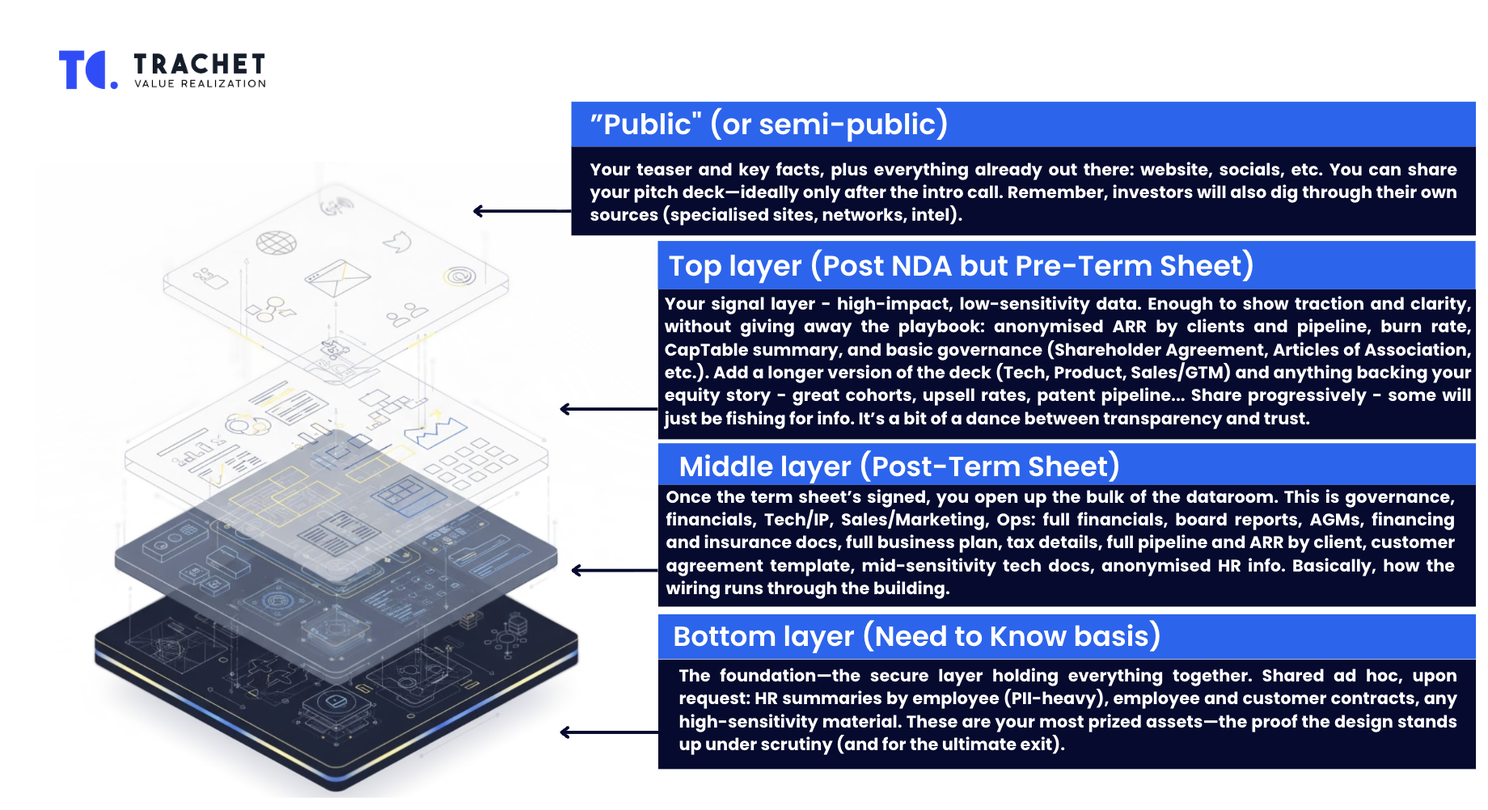
The Layered Data Room Blueprint
Many founders think more disclosure equals more trust; in reality, the opposite is true. A well-managed blueprint shows confidence, not desperation.
Tailoring to Your Risks No two processes should follow the exact same blueprint - however consistency during a transaction is key. An AI-driven SaaS startup won’t face the same questions as a regulated fintech. The approach we take is to map where the structural risks lie - IP, compliance, HR - and make sure the data room anticipates those areas of inspection. And then we ensure all parties are bound by the same rules to progress.
The best data rooms don’t just inform; they guide. They lead the investor’s eye through the structure in a way that builds conviction, not confusion.
What “Dynamic” Looks Like in 2025
Investors now expect founders to be ready from day one. Some of the companies I work with maintain “always-on” data rooms, updated monthly, so diligence can begin within hours rather than weeks.
They expect thorough and well-organised content - every claim in your pitch deck should reconcile with what’s in the files. They expect collaboration - Q&A logs inside the room are now standard. And increasingly, they expect maturity - sometimes with summaries to help them digest the information.
For founders and CFOs, the data room is one of the few things you fully control during a deal. Treat it like a product - layered, current, and designed with intent. Done right, it doesn’t just support diligence - it sets the pace, builds trust, and keeps the leverage with you.
News Roundup
Trachet in the news
Your go-to roundup of Trachet in the news, key deals in the UK/EU startup arena, and emerging trends to watch.
→ VCs Urge Founders to Raise before AI Bubble Bursts – Sifted
Europe’s AI boom is showing signs of overheating, with investors warning that record funding levels could soon give way to a correction. Claire Trachet told Sifted that founders should “raise earlier, and a little more,” advising startups to secure 24–30 months of runway to weather a potential downturn in 2026. As European AI startups raise nearly double last year’s total, Claire cautioned that valuations are increasingly detached from fundamentals - urging founders to plan ahead and preserve optionality before investor sentiment cools.
→ Klarna could trigger a fintech IPO boom but can London benefit? – City A.M.
Klarna’s $15bn New York IPO reignited investor appetite for fintechs but highlighted London’s ongoing struggle to attract listings. Claire noted the debut “underlines the gulf between the US and UK public markets,” with firms like Revolut turning to secondary sales instead of IPOs. She warned that without deeper liquidity, a broader investor base, and faster regulation, the UK risks becoming “a market defined only by consolidation at the top.”
→ Could dual listings ignite UK’s frozen capital markets? - Raconteur
Dual listings are emerging as a lifeline for London’s struggling capital markets, offering companies access to US liquidity while retaining European credibility. Claire noted that such listings “create options for founders and investors” and can “re-open exit routes that have been effectively frozen in the UK.” She cautioned, however, that without reforms to barriers like stamp duty and rigid governance rules, London risks becoming a secondary venue for globally ambitious firms.
→ London fintech eyes IPO as Klarna’s listing puts pressure on the City - City A.M.
SumUp is weighing a $15bn IPO that could hand London a much-needed fintech win - but the firm is also eyeing New York amid doubts over the City’s appeal. Claire warned that Klarna’s Wall Street success “underlines the gulf between the US and UK public markets,” cautioning that without deeper liquidity and a broader investor base, London risks “becoming a market defined only by consolidation at the top.” With UK fintech investment down 5% in H1 2025, SumUp’s listing decision could be a pivotal test of confidence in Britain’s capital markets.
→ Wise's US listing could signal the death knell for London's fintech IPO revival - Business Live
Wise’s shift to a US-primary dual listing deals another blow to London’s fintech IPO revival, reinforcing the gap in liquidity and sentiment. Claire argued the “crown jewel” moment has faded - Wise’s move shows UK markets still aren’t meeting high-growth companies’ needs. Without a bold government signal on liquidity, visibility and ambition, fintechs will treat the LSE as second choice, making July’s Treasury strategy pivotal.
What we’ve been reading
→ AI’s double bubble trouble - Financial Times
The Financial Times’ John Thornhill argues that we’re in two AI bubbles simultaneously — one productive, driving real innovation, and one speculative, fuelled by inflated valuations and hype. Drawing parallels with the dotcom boom, Thornhill notes that while bubbles can accelerate progress, they often end in waste and disappointment when expectations outpace reality. He concludes that AI’s economic promise is real but currently overvalued, warning that the sector’s heavy spending on hardware and talent must translate into sustainable, long-term returns.
→ UK startups lay out demands for ‘make or break’ Budget - Sifted
Sifted reports that UK startups are warning of a ‘make or break’ moment ahead of the next Budget. Groups like Startup Coalition and Boardwave are urging the Chancellor to avoid tax hikes on founders and investors, arguing that higher rates could push capital and talent overseas. Proposals include raising SEIS/EIS limits, expanding EMI schemes to later-stage firms, and restricting non-compete clauses to support growth. There are also fears that new tax reforms - such as adding employer NI to LLPs - could make UK venture funds commercially unviable.
→ AI helps big corporations build start-ups faster and cheaper - The Times
According to The Times, AI is helping large corporations build profitable startups faster and at lower cost. McKinsey found that average investment to break even has dropped to £57.7m (from £93.6m in 2024), while time to reach £7.5m in revenue has fallen to 31 months. AI-native ventures generate four times more revenue than non-AI peers by optimising marketing, procurement, and manufacturing, and corporations that have launched multiple ventures achieve double the revenue growth per dollar invested thanks to accumulated experience.
→ Europe Venture Fund Lakestar Calls Halt On New Startup Bets - Forbes
Lakestar will stop raising new “generalist” VC funds, with founder Klaus Hommels telling LPs he will use his own capital for future bets and focus on supporting existing portfolio companies including Revolut, Helsing, and Isar Aerospace. The firm plans to prioritise maximising current holdings and may seed ex-Lakestar team members to launch new funds. The move reflects a wider European VC fundraising slump - just $8bn raised so far in 2025 compared to $27bn in 2024 - despite continued investor interest in AI and defence.
→ UK Lacks Growth Funding for Critical Sectors Like Quantum, AI - Bloomberg
According to Bloomberg, UK spinouts in high-value sectors such as AI, quantum, and life sciences are struggling to scale due to a shortage of domestic growth-stage funding. Research from Parkwalk Advisors and Beauhurst shows that while nearly 1,000 university spinouts raised up to £5m over the past five years, only a handful secured rounds above £20m - and just three exceeded £500m. The resulting funding gap has driven a surge in foreign investment since 2021, creating a “gravitational pull” drawing UK innovation overseas and prompting calls for a national strategy to retain critical tech industries.
We’re keen to hear about the key challenges (or opportunities!) shaping your company’s objectives in Q4 of 2025. Email us at claire@trachet.co for more information on topics you'd like to see discussed in future issues of What’s the deal?
