
What's the deal? The Tech M&A & Fundraising Newsletter - H1 Roundup: Improving the odds
H1 Roundup: Improving the odds
European venture funding rose sharply in H1 2026, but most companies remain outside the megadeal market. For founders targeting capital where it is still scarce, improving the odds means looking beyond a standard fundraise. This July edition explores how better timing, stronger positioning and greater optionality across equity, debt, strategic investment and M&A can help companies achieve their objectives in H2.
Welcome to What’s the Deal? - your monthly deep dive into the strategic forces shaping the tech investment landscape. This July edition looks back at H1 2026 and asks what the broader market - companies outside the small group of fundraising outliers - can do now to put themselves in a stronger position for their next transaction.
A note from the Editor - CEO Claire Trachet
“The first half of 2026 produced one of those markets where the headline data and the experience of raising capital tell two different stories. Funding increased significantly, and large investors showed that they remain willing to deploy substantial capital. However, across the broader market - the companies outside the small group of fundraising outliers - founders are encountering longer processes, greater hesitation among potential lead investors and a growing divide between companies attracting immediate conviction and everybody else - even for objectively "good" companies.
“Across Europe, Crunchbase recorded US$42bn invested during H1-26, up 50% year on year. But the recovery was highly concentrated. In Q2-26, just 42 companies raising US$100m or more received 65% of all capital invested, while four billion-dollar rounds alone represented a quarter of the quarter’s total.
"The megadeals are real evidence of investor confidence - however it shouldn't be the signal of a healthy ecosystem.
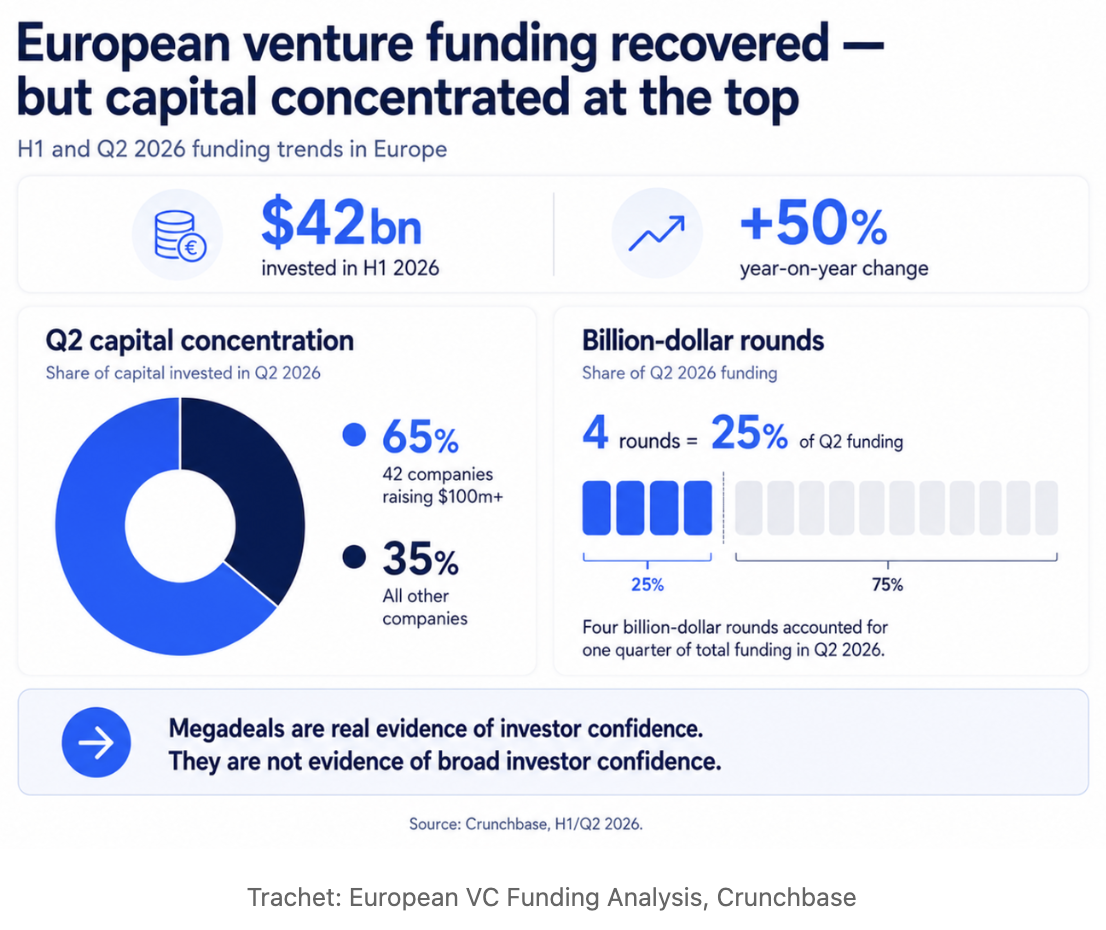
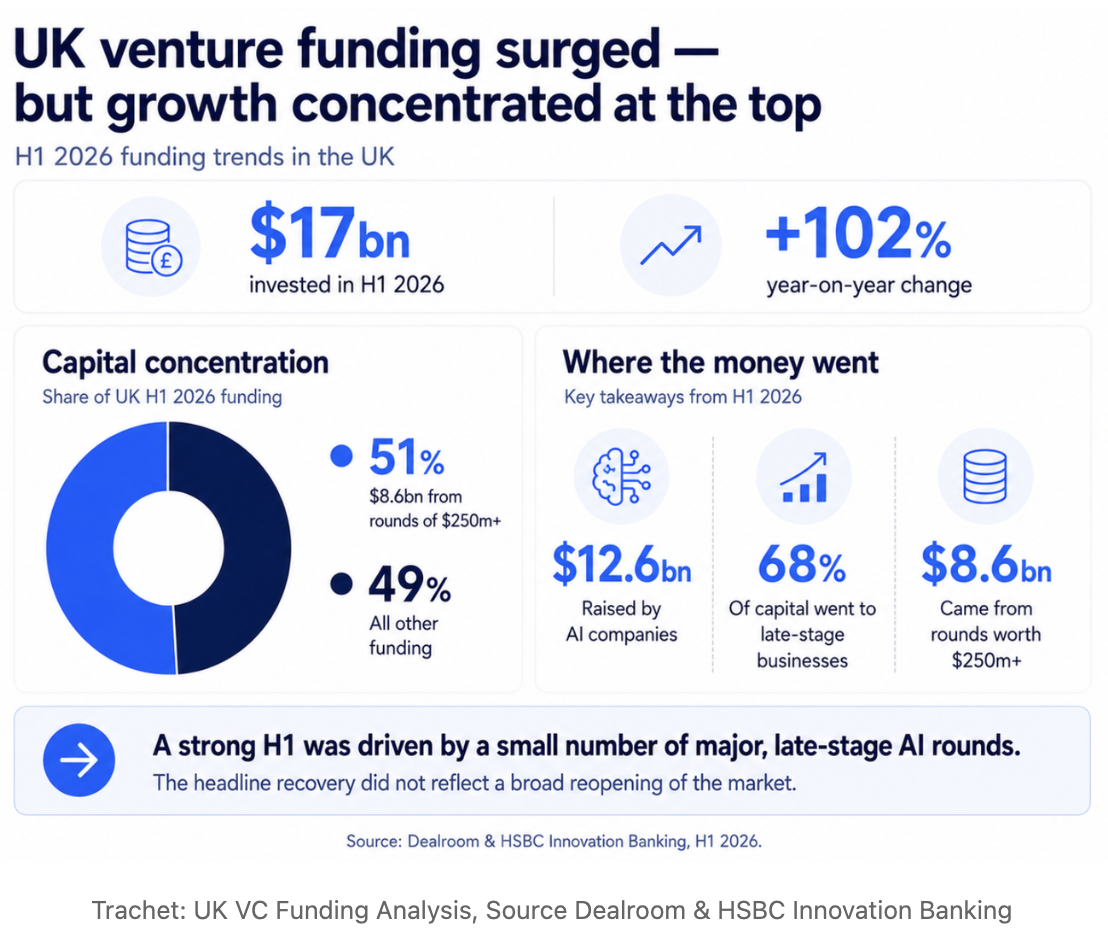
“The same pattern was visible in the UK. Dealroom and HSBC Innovation Banking recorded US$17bn of venture funding during H1-26, up 102% year on year. But rounds of US$250m or more accounted for US$8.6bn - more than half of everything invested.
"AI companies raised US$12.6bn in the UK, while late-stage businesses received 68% of total capital. The UK had a strong first half, but relied on a relatively small number of major, late-stage AI rounds, a trend seen globally.
“For founders and investors, the more useful question is what happens to the broader market. These are often good companies with real customers, credible technology and experienced teams. But in the current challenging market environment, where expectations are high and goalposts keep moving - they may not yet have the growth, strategic importance or market momentum that makes the next institutional round obvious. The difficult part of the market is not always the very beginning or the very top. It is the point at which a company must persuade a new investor or existing investor that PMF is reached on one or several verticals in order to price the next phase of risk.
“This is where we believe the analysis must become tailored to the company. What would cause the market to value this business differently six months from now? Is it another period of incremental growth, or does the company need a genuine re-rating event: stronger retention, lower customer concentration, a major enterprise contract, better margins, regulatory approval or a credible route to breakeven? And if the current strategy has left the company within the non-outlier majority, should more capital simply fund more of the same?
“The other question is whether the company has a financing problem or a strategic problem. A missing product capability, limited distribution or insufficient scale may not be solved most effectively through another equity round. Well-funded startups are increasingly using acquisitions to buy technology, talent, customers and market access. Sifted counted 753 European startup acquisitions between May 2025 and May 2026 and found that a growing number of venture-backed companies are raising specifically to buy. A business that looks unexceptional to a generalist financial investor may still be highly valuable to the right strategic buyer.
“For companies competing for capital where it remains scarce in terms of number of transactions, H2-26 should be about improving the odds rather than simply preparing another fundraising process. That means defining what the company needs to achieve, identifying the milestone that would change the conversation and building enough optionality to consider equity, debt, strategic investment, acquisition or M&A. Before preparing the deck or approaching investors, founders and Boards need to agree what problem the next transaction must solve - and which alternative remains credible if the preferred route is not available. Creativity and agility are essential to navigating a bifurcated market in which capital remains available, but only a small number of companies benefit from its concentration."
The goal is not to find one universal AI strategy. The goal is to build a decision-making process that is clear, consistent and can be iteratively improved.
Deep Dive Three ways to improve your odds in H2-26
H1-26 showed that capital has not disappeared. It has become more even more selective and concentrated on a few transactions.
For companies outside the megadeal market, the answer is not simply to prepare a better version of the same fundraising process. The more useful task is to identify what would cause the company to be valued differently, understand where its strategic value may exceed its financial profile and preserve enough optionality to act on either route.
1. Look for a re-rating event, not incremental progress
One of the risks for companies in the broader market is assuming that one or two quarters of progress will automatically improve the next round.
It may not.
If revenue, retention and margins improve only modestly by investors' definition / benchmarks, investors may still reach the same conclusion at the end of the period. The company has become better, but not different enough to attract a new set of investors or justify materially better terms.
The focus should therefore be on a re-rating event: a milestone development that changes the way investors or buyers categorise the company.
That could be:
a major enterprise contract that validates the sales model;
reaching breakeven earlier than expected;
materially improving gross margin;
reducing dependence on one customer;
gaining regulatory approval;
proving a second product or market;
or acquiring a capability that changes the growth profile.
geographic expansion: a few landmark deals in a targeted country
The important test is not whether the milestone is positive. It is whether it changes the external narrative.
Consider
What is currently keeping the company in the "middle of the pack" for an outside observer?
Which milestone would materially expand the investor/acquiror universe?
Would another six months of the current plan genuinely change the final prospects or only move along currently expected plan ?
Practical action
Agree with the Board the event(s) most likely to change how the company is valued.
Then align the operating plan, available runway and launch date around producing and proving it.
2. Position the company as an asset, not only as a standalone growth story
The concentration of funding at the top has created a second-order effect: the best-funded startups now have capital to buy.
They are acquiring technology, specialist teams, data, customers, licences and distribution rather than waiting to build everything organically.
This creates another source of optionality for companies outside the small group of funding outliers. A business that may not attract immediate conviction as a standalone growth story can still own assets that are highly valuable to a better-capitalised strategic buyer.
A business may struggle to demonstrate the growth profile required by a financial investor, while still owning something that would be expensive, slow or difficult for a better-capitalised company to recreate.
That strategic value may sit in:
a proprietary dataset;
an embedded customer workflow;
regulated market access;
technical talent;
a strong position in one geography;
a trusted brand in a specialist category;
or a product that fills a clear gap in another company’s platform.
The mistake is presenting the company only through its standalone financial trajectory.
Consider
What does the company own that another business would struggle to reproduce?
Which better-funded companies have a gap that this business could fill?
Would they be buying revenue, time, talent, data, distribution or market position?
Is that strategic value visible in the company’s current positioning?
Practical action
Create a one-page strategic value map.
Identify five to ten companies for which ownership of the business could create more value than partnership or internal development. For each, define the specific acquisition rationale - not simply that they are a large company in the same sector.
Not sure whether the better route is to raise or exit? Use Trachet’s Exit Calculator to compare the two options in practical terms, including the capital required, the value that would need to be created and the potential outcome for shareholders.
3. Use dual-track planning to improve both outcomes
Dual-track planning should not be treated simply as a fallback for a failed fundraise.
Used early enough, it can improve the quality of both the fundraising and M&A options.
Understanding the strategic buyer universe helps management identify which assets matter most, where market consolidation is taking place and how the company should position its next phase of growth.
At the same time, strategic conversations can strengthen the standalone investment case. A commercial partnership, distribution agreement or minority strategic investment may validate the company without requiring an immediate sale.
The company should not create confusion by openly marketing several different transactions at once. But the Board should seek tangible market feedback on both the financing and strategic routes before committing all available runway to one process.
It should also remain sufficiently prepared and opportunistic to respond to credible inbound interest if it emerges, rather than treating every strategic conversation as something to revisit only after a fundraising process has failed.
The distinction is important:
an investor wants to know how capital creates a more valuable standalone business;
a buyer wants to know why ownership creates more value than building, partnering or competing.
The facts remain the same. The value-creation case is different.
Consider
Which investors could genuinely lead rather than follow?
Which strategic buyers have a reason to act within the next 12 months?
Could a commercial relationship become an investment or acquisition route?
What event would cause the Board to move from fundraising to M&A?
Is there enough runway to develop both routes before either becomes urgent?
Practical action
Build a simple dual-track plan containing:
the credible lead-investor universe;
the strategic buyer and partner universe;
the re-rating event relevant to each;
the relationships that should be developed now;
and clear dates for continuing, delaying or redirecting the process.
Final takeaway
For companies outside the megadeal market, improving the odds is not about generating more activity.
It is about creating a development that causes the market to reassess the company, making its strategic value visible to the businesses with capital to acquire, and developing both the financing and M&A routes before runway weakens the choice.
The objective is not to look marginally more fundable six months from now.
It is to become materially more valuable - and to more than one type of counterparty.
News Roundup
Your go-to monthly roundup of Trachet in the news, key deals in the UK/EU startup arena, and emerging trends to watch.
Trachet in the news:
Trachet in the news:
→ The groupthink trap: similarity is a ticket to failure - Institute of Directors Magazine
Director Magazine examined how groupthink can weaken board decision-making. Claire highlights how influential investors and strong company performance can discourage challenge, allowing assumptions to go untested.
→ European shares steady as tech weakness offsets US-Iran optimism - Reuters
Reuters examined the competing forces shaping European markets, as lower oil prices supported sentiment while concerns over Chinese chipmaking advances weighed on technology stocks. Claire Trachet contributed her perspective on investor sentiment towards AI and European technology, highlighting how capital remains committed to the sector but is becoming increasingly selective about where it sees lasting value.
What we’ve been reading:
→ Digital Bank Revolut Valued at $115 Billion - The Wall Street Journal
Revolut has launched a secondary share sale valuing it at $115bn, giving employees and early investors liquidity without an IPO. The signal is that exceptional private companies can increasingly reward shareholders while remaining private—but that flexibility is still reserved for a small group of outliers.
→ 9fin completes first employee share sale - Sifted
Debt-market intelligence platform 9fin has allowed eligible employees to sell shares following its $170m Series C. The deal shows how secondary sales are becoming an important retention and liquidity tool for well-funded private companies.
→ France questions UK role in EU’s €5bn Scaleup Fund - Financial Times
France has raised concerns over UK participation in the EU’s €5bn growth fund. The dispute shows how political fragmentation could restrict the capital and market access available to European scaleups.
→ UK pension providers discuss £1bn Scale-Up Fund - Sifted
Major UK pension providers are working with the British Business Bank on a proposed £1bn technology fund. The opportunity is significant, but its impact will depend on how quickly and broadly the capital is deployed.
→ The rise and fall of the UK’s tech department - Politico
Politico examines the decision to absorb the UK’s dedicated technology department into a broader business ministry. For founders, the real test is whether the change improves coordination across funding, regulation and procurement—or creates more uncertainty.
→ How Britain can turn technology into a £100bn superpower - The Times
Saul Klein argues that Britain excels at invention but struggles to build global companies from it. His prescription is stronger procurement, greater domestic investment and closer coordination between science and economic policy.
→ British venture funding is booming—if you are an AI firm - The Observer
UK venture funding reached $17bn in H1 2026, but nearly three quarters went to AI companies while early-stage investment weakened. The figures point to a highly concentrated recovery rather than a broad-based funding boom.
We’re keen to hear about the key challenges (or opportunities!) shaping your company’s objectives in 2026. Email me at claire@trachet.co for more information on topics you'd like to see discussed in future issues of What’s the deal?
