
What's the deal? The Tech M&A & Fundraising Newsletter - Europe’s Exit Engine: Making M&A work
Europe’s venture ecosystem continues to attract capital, but much of the value created remains held in private companies. With IPOs accounting for only 2% of VC-backed exits, acquisitions have become the most common route through which technology companies secure strategic outcomes and return capital to shareholders.
M&A is not only an exit route. For companies that have moved beyond an early sale but have not yet reached the scale required for a larger outcome, acquisitions can provide the technology, talent, customers and market access needed to grow. After more than a decade building its early-stage ecosystem, Europe increasingly has the capital and experienced founders to pursue these opportunities rather than waiting for larger companies to determine their future. Boards in turn, must decide who is responsible for creating and protecting those strategic options.
Welcome to What’s the Deal? - our monthly examination of the forces shaping European technology. Following Trachet’s contribution to the XAnge M&A Report, this edition introduces a seven-step exercise to help founders and boards decide when to build, partner or buy as a route to achieving their ambitions.
A note from the Editor – CEO Claire Trachet
“This edition of What’s the Deal?, produced by Trachet following its contribution to European venture capital firm XAnge's M&A playbook, examines the opportunity for M&A to play a larger role in the development of European technology companies.
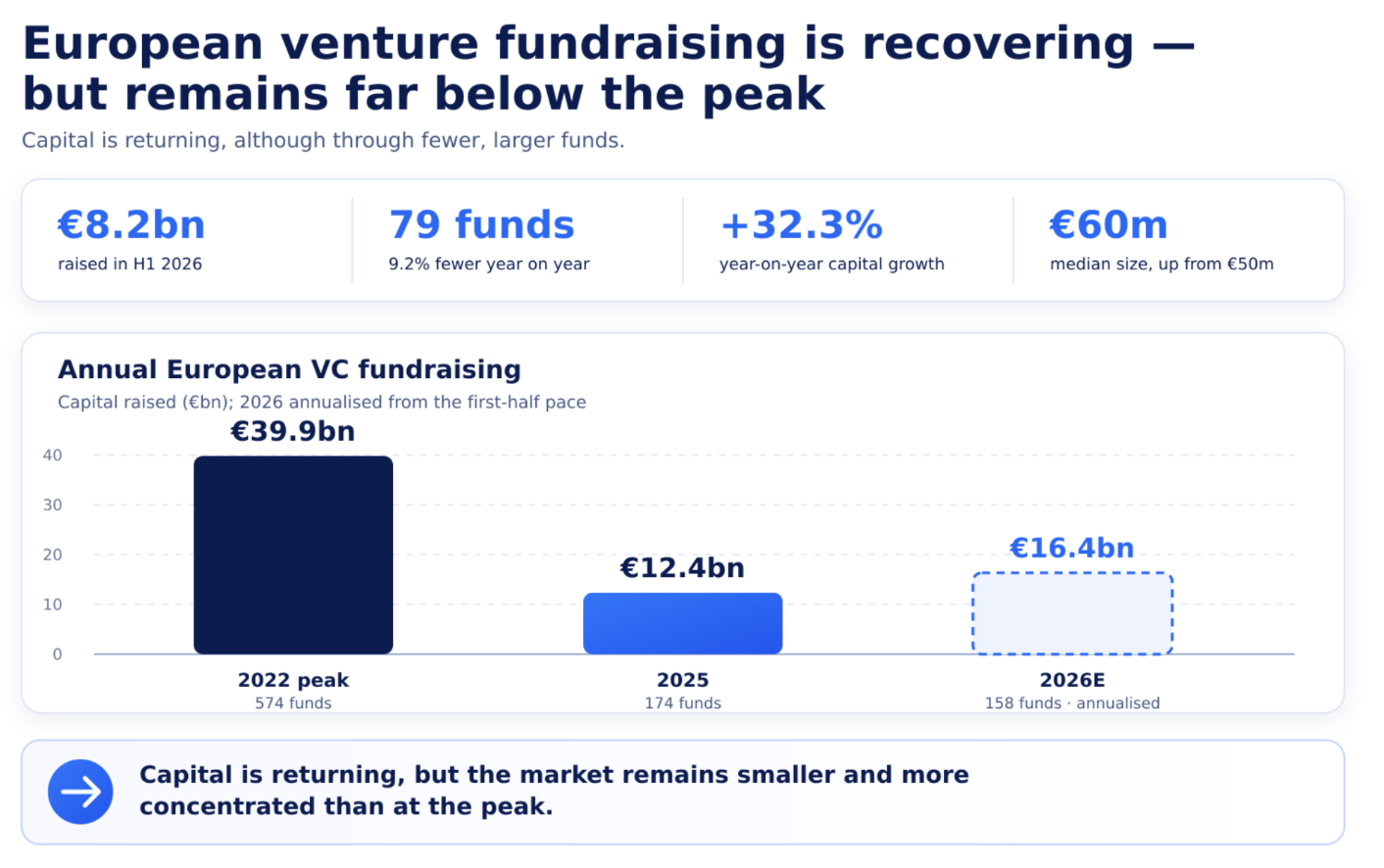
“Europe’s venture market continues to attract capital, which is increasingly concentrated in fewer hands. In the first half of 2026, European VC funds raised €8.2bn across 79 vehicles. That was 32.3% ahead of the equivalent 2025 pace by value, although the number of funds remained 9.2% lower. The median fund size increased from €50m in 2025 to €60m in the first half of this year.
“That represents an encouraging change after European VC fundraising fell to €12.4bn across 174 funds in 2025, down from a peak of €39.9bn across 574 funds in 2022, according to PitchBook’s Q2 2026 European Venture Report. If the first-half pace continues, European funds could raise approximately €16.4bn across 158 vehicles in 2026 - a modest recovery, but still considerably below the market’s peak.”
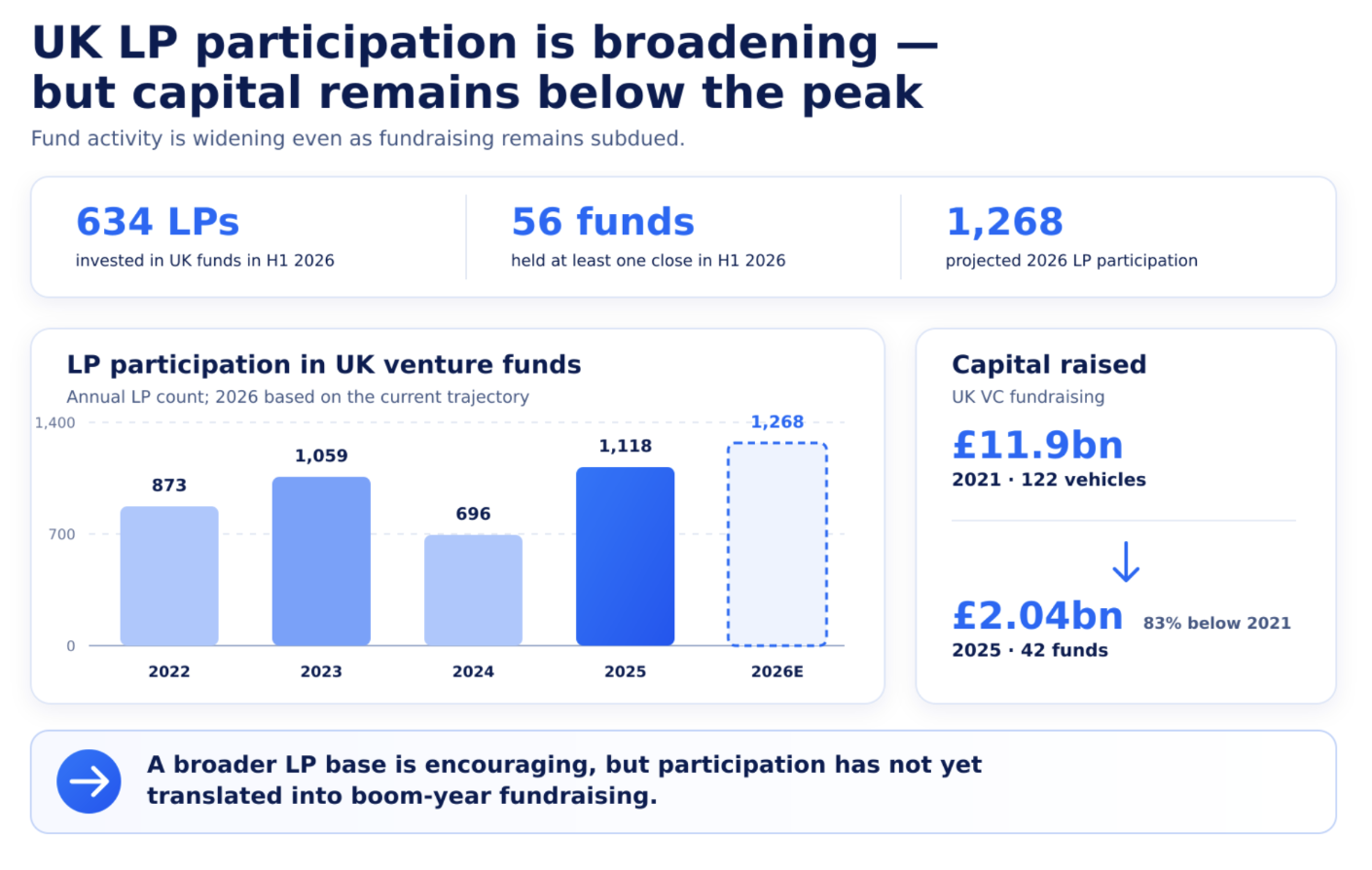
“The UK tells a similar story: participation is broadening, even if fundraising remains well below the market’s peak. During the first half of 2026, 56 UK-domiciled funds held at least one close, attracting commitments from 634 LPs. If that pace continues, the year could record the highest number of participating LPs since the dataset began in 2021. Yet the comparison with the boom years remains stark: UK VC funds raised £11.9bn across 122 vehicles in 2021, against £2.04bn across 42 funds in 2025.
“There are, however, signs of renewed momentum. By 3 September, our review of publicly announced 2026 closes had identified more than £1.5bn in headline fund sizes in the UK, including vehicles from QuantumLight, Seedcamp and 2150. Alongside major European funds from Jeito Capital, Kembara and Hummingbird Ventures, these closes suggest that LP capital is available and willing - but increasingly concentrated around established managers and clearly differentiated strategies.”
“Europe therefore has capital available for its next generation of companies. It also has a considerable stock of value already held within existing venture portfolios.
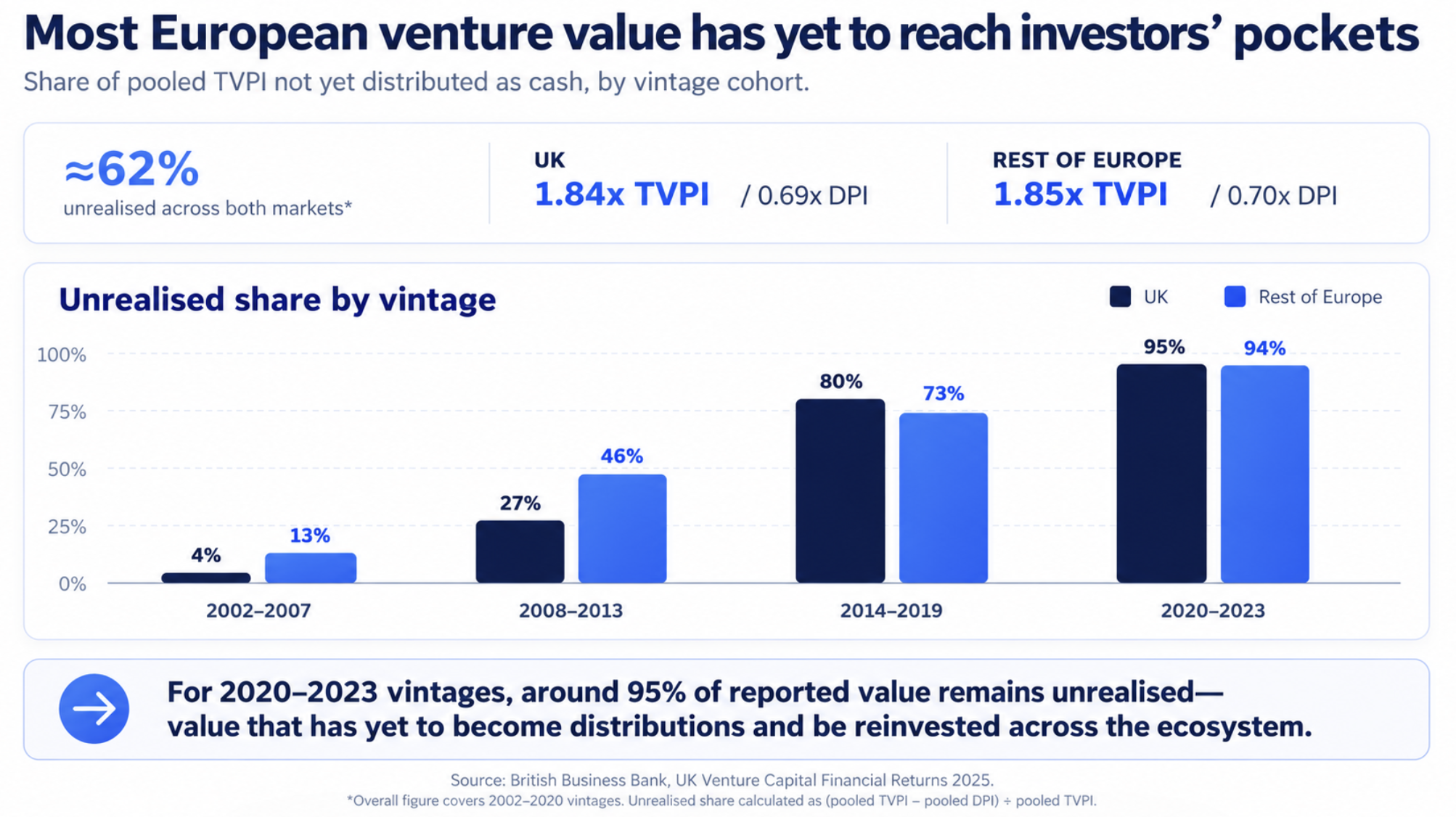
“According to the British Business Bank's UK Venture Capital Financial Returns 2025 report, European VC funds outside the UK with 2002–2020 vintages, pooled TVPI stands at 1.85x, while DPI is 0.70x. The UK is almost identical, with TVPI of 1.84x and DPI of 0.69x. In both markets, approximately 62% of reported value remains unrealised. The concentration is greatest among more recent funds: around 80% of UK fund value from 2014–2019 remains unrealised, rising to 95% for 2020–2023 vintages. The equivalent figures for the rest of Europe are 73% and 94%.
“Fewer than a third of European funds outside the UK with 2002–2020 vintages have returned more than their investors’ original capital in cash. The UK is almost identical at 30%, compared with 43% in the US. This is a fund-count comparison rather than a measure of capital returned, and reflects ecosystems of very different scales: between 2013 and 2023, US VC funds raised $924bn, more than seven times the $130bn raised by EU funds. Europe’s opportunity is therefore not only to create more value, but to convert more of the value already held in private companies into distributions that can be reinvested across the ecosystem.”
“M&A is already central to that process. Tracxn recorded 559 European technology acquisitions during the first half of 2026, compared with only 8 IPOs, meaning 98% of exits were M&A focused. The UK, Europe’s largest technology market, recorded 326 M&A transactions during the same period.
“These figures should not be read simply as evidence of a difficult IPO market. They show that acquisitions are the route through which European technology companies are most commonly securing strategic outcomes, joining larger platforms and returning capital to shareholders.
“Europe has spent more than a decade building valuable technology, specialist talent, data, intellectual property and positions in regulated markets. Better-capitalised companies now have an opportunity to acquire those capabilities, expand into new markets and build the scale required to compete internationally. For founders and investors, a more active M&A market can create liquidity while keeping more technology, expertise and future growth within the European ecosystem.
“That opportunity requires preparation. Boards should increasingly focus on assigning responsibility for strategic-option planning to a named executive and board sponsor, then map potential acquirers into clear buckets: those that may value the company’s technology or talent today; those that would become relevant after specific product, customer or geographic milestones; and larger buyers that may only engage once revenue reaches €20m - €30m.
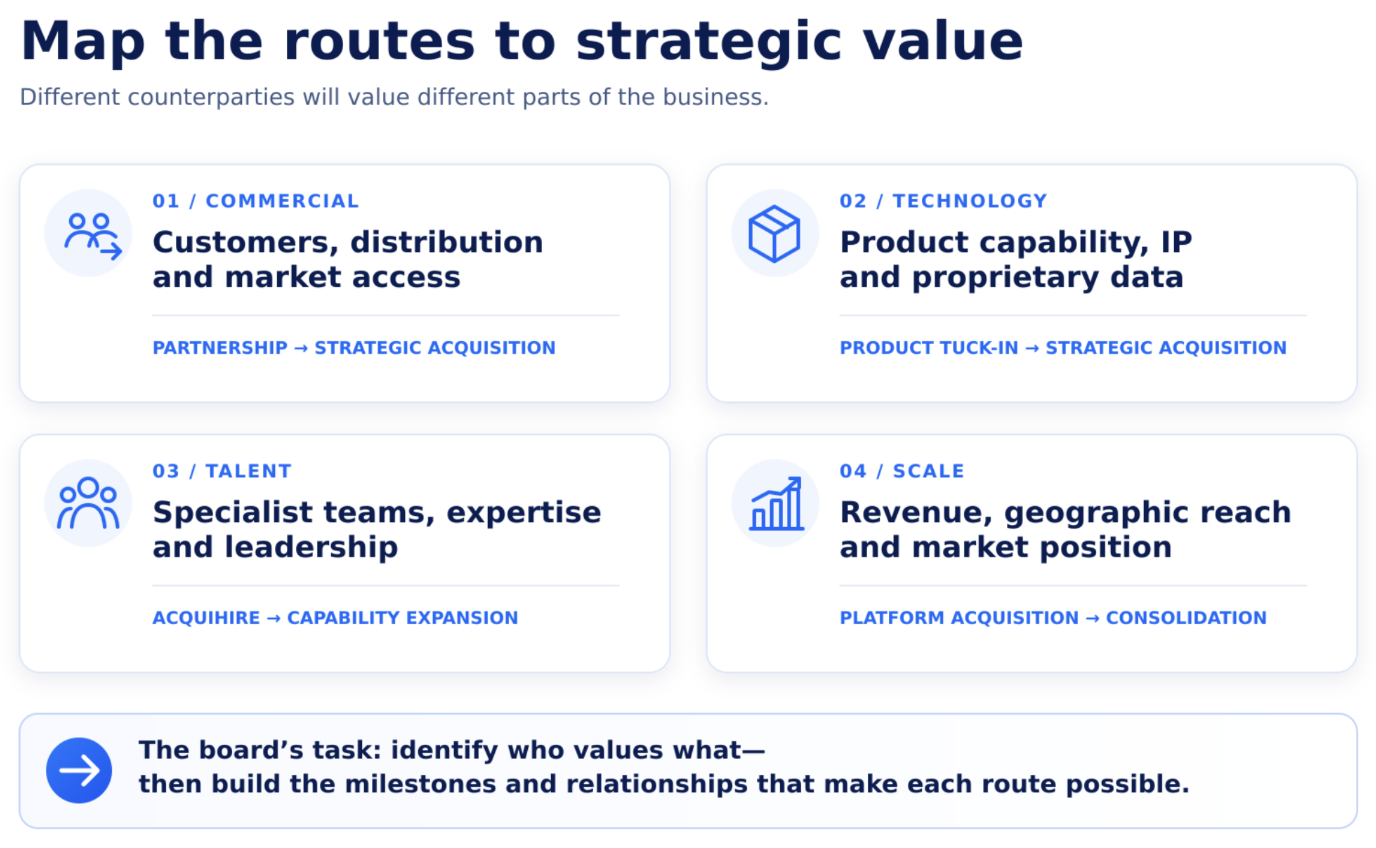
For each group, the board should understand the strategic rationale, the relationships to build and the gaps that must be closed. Exit planning does not mean deciding to sell - it means creating the conditions for opportunities to emerge, rather than waiting for a buyer to appear.”
“M&A should also be considered as a means of building value ahead of an eventual exit. The right acquisition can add technology, talent, customers, distribution or geographic reach more quickly than developing them internally. It can change how the market values the business and open strategic options that would otherwise take years to create.
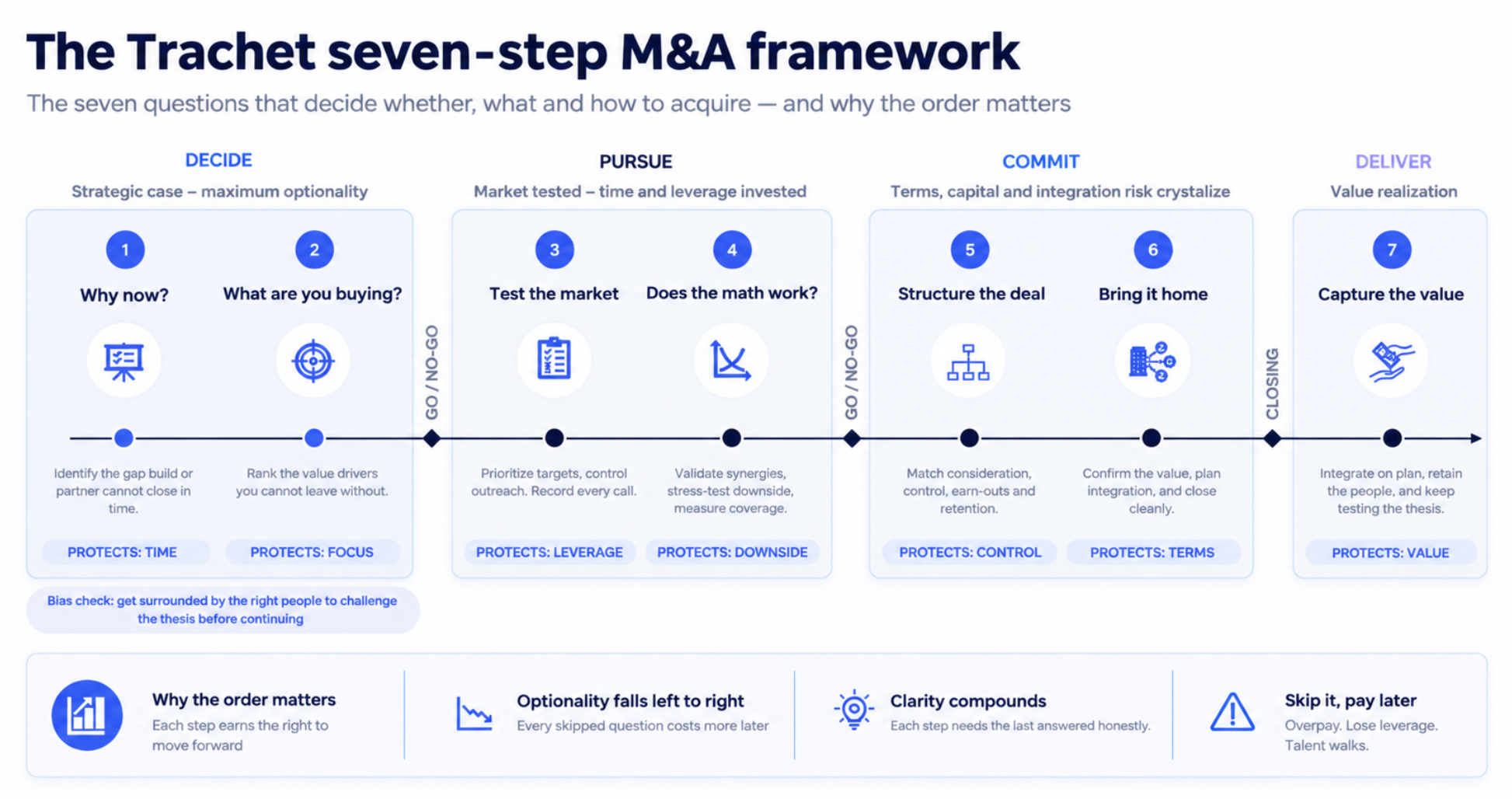
“Following our contribution to XAnge’s M&A Report, we are publishing our seven-step exercise to help founders and boards assess M&A as a route to growth. It covers when buying may be preferable to building or partnering, what the company is seeking to acquire, how to test the market and valuation, how to structure and complete the transaction, and how to capture value after closing.”
“The purpose is to make M&A a considered part of corporate strategy: one that can unlock the value already created across European technology and help build stronger companies for the next stage of growth.”
Deep Dive: A seven-step M&A exercise for founders and boards
An acquisition can accelerate years of product development, hiring or market expansion, but a deal should not begin with a target. It should begin with a clear strategic need. This seven-step exercise helps founders and boards test whether buying offers a stronger route than building or partnering, then carry that rationale through valuation, execution and integration.
Work through the steps in order, using each to reach a clear decision and produce a practical output. The purpose is not to justify a transaction, but to determine whether to proceed, pause or walk away—and, if the deal moves forward, protect the value that made it attractive.
01 / Why now?
Core takeaway from the exercise
By the end of this exercise, you should be able to explain why M&A is the right route now, not just why a particular target looks interesting.
The output is a clear view of the strategic gap you are trying to close, the realistic alternatives available to you - build, partner or buy - and the cost of waiting.
M&A should only move forward if acquisition solves a timing, capability or market-position problem that building or partnering cannot solve quickly enough.
Founder questions
Use these before discussing any specific target:
Which capability gap would materially change the business over the next 12, 24 and 36 months?
What specific milestones are we missing without it: revenue, margin, product, regulatory, geographic, customer access or team capability?
What is the realistic time-to-value if we build, partner or buy?
What risks would acquisition introduce that building or partnering would not?
If we wait six months, what becomes harder, more expensive or less defensible?
How to approach the exercise
Start with the gap, not the target. Complete this sentence before any company is named: “We are considering M&A because we need to…”
Then compare build, partner and buy against the same criteria: time-to-value, cost, execution risk, management distraction and control.
M&A should only move forward if buying clearly saves time or unlocks capability that the other routes cannot deliver quickly enough.
Trachet lens
In our experience, weak deals often begin when a target becomes exciting before the strategic need is clear.
M&A should start as a capital allocation decision under time pressure. The question is not simply whether a company can be bought, but whether buying it creates a better route to value than building or partnering.
If the cost of waiting cannot be articulated, the reason to buy is usually not strong enough yet.
Output of the exercise
A one-sentence strategic rationale, a build / partner / buy comparison, and a clear go / no-go view on whether M&A is the right path now.
02 / What are you actually buying?
Core takeaway from the exercise
By the end of this exercise, you should be able to explain what specific value you are trying to acquire - and which parts of that value justify the price.
The output is a ranked list of the value drivers you cannot leave without: technology, traction, talent, customers, IP, data, geography, regulation, distribution or brand.
A company is never one asset. It is a bundle of value, risk and dependencies. The exercise is to separate what you want from what simply comes with the target.
Founder questions
Use these before valuation discussions begin:
If we broke the target into parts, which assets or capabilities would we still actively want to own?
Which two value drivers matter most: technology, traction, talent, customers, IP, data, geography, regulation, distribution or brand?
What must still be true 12 months after close for us to say the acquisition worked?
Which value drivers transfer on Day 1 post closing, and which depend on people staying, customers renewing or integration working?
What part of the purchase price can we not yet explain?
How to approach the exercise
Break the target into its underlying value drivers: technology, traction, talent, customers, IP, data, geography, regulation, distribution or brand.
Rank the two or three drivers the deal cannot work without. Then separate what transfers automatically from what depends on people, customers or integration.
The clearer the value drivers, the easier it becomes to price the deal, diligence the right risks, structure the terms and protect value after closing.
Trachet lens
In our experience, founders often overpay when they cannot separate the asset they want from the story they have started to believe.
“Strategic” is not enough. If the value driver cannot be isolated, the premium is probably faith, not strategy.
A good acquisition thesis should be clear enough to explain on one page: what we are buying, why we need it, what it is worth to us, and what has to transfer after closing for the deal to work.
Output of the exercise
A ranked value-driver map, a clear explanation of what justifies the price, and a list of the assets, people or relationships that must be protected for the acquisition thesis to hold.
03 / How do you test the market?
Core takeaway from the exercise
By the end of this exercise, you should know whether the target in front of you is genuinely the best route, or simply the first available route.
The output is a prioritised target map, a tactical outreach plan, and a clear go / no-go process for assessing each opportunity.
Market testing should protect focus, leverage and relationships. It should help you understand the available universe of targets without distracting the management team or creating unnecessary noise.
Founder questions
Use these before approaching targets:
What target profile are we testing, and what would disqualify a company immediately?
Which 10–20 companies could solve the same strategic gap?
What three criteria will we use to rank those targets?
Who should make the first approach, and what signal do we want from the first conversation?
What would make us stop pursuing a target after the first or second conversation?
How to approach the exercise
Build the target profile before approaching companies. Define what good looks like, what would disqualify a target, and which criteria will be used to rank options.
Run the same process across each conversation: same core questions, same tracking, same weekly go / no-go discipline.
The aim is not to turn the process into a fishing expedition. It is to compare real alternatives, reduce bias and preserve leverage.
Trachet lens
In our experience, discipline upfront protects both the relationship and the deal.
An adviser can be useful here not simply because they can make approaches, but because they can test availability, confirm information and structure early conversations without putting too much load on the management team.
The aim is to collect enough information to keep qualifying the opportunity, without overwhelming the target too early or signalling more than you intend to.
Output of the exercise
A prioritised target map, a standardised outreach plan, call-tracking notes, pass / fail criteria, and a clear decision on which targets deserve deeper engagement.
04 / Does the maths work?
Core takeaway from the exercise
By the end of this exercise, you should know how much of the purchase price is supported by evidence, and how much depends on future execution.
The output is a conservative value case that separates standalone value, validated synergies, cost-to-achieve, downside risk and the remaining execution gap.
A deal can be strategically attractive and still fail financially. The purpose of this exercise is to make sure the acquisition thesis works not only in the upside case, but in the cases where things take longer than expected.
Founder questions
Use these before agreeing headline value:
What is the target worth on a standalone basis before synergies?
Which value drivers are actually reflected in the valuation?
What synergies are we assuming in year one, and which of them are in our control?
What is the cost of achieving those synergies?
How much of the purchase price is covered by standalone value plus year-one net synergies?
How to approach the exercise
Start with the target’s standalone value before adding synergies.
Separate cost synergies from revenue synergies, then subtract the cost of achieving them. Do not treat all synergies with the same level of certainty - this will be your buffer for negotiating the acquisition price, depending on your risk appetite.
Stress-test the downside case. The key question is whether the deal still works if parts of the plan don't materialise or arrive later than planned.
Trachet lens
In our experience, founders are often very good at explaining the upside case. The harder and more valuable work is building the case that still makes sense when the upside is delayed.
This is where valuation discipline matters. If too much of the price depends on future synergies, the deal may still be possible, but the structure needs to reflect that risk.
The question is not only “how big could this become?” It is also “what still works if the plan takes longer than expected?”
Output of the exercise
A conservative value bridge showing standalone value, validated synergies, cost-to-achieve, first-year value coverage, downside risk and the portion of the price that remains highly dependent on a successful execution.
05 / How should the deal be structured?
Core takeaway from the exercise
By the end of this exercise, you should understand what type of transaction you are actually doing, and how the structure should protect the value you are buying.
The output is a proposed deal structure that reflects the value drivers, risk allocation, control dynamics, runway impact, dilution and post-close incentives.
Price is only one part of the deal. Structure determines how much risk is shared, how much value is paid for upfront, what still has to be delivered, and whether the people carrying the value remain aligned after closing.
Founder questions
Use these before issuing an LOI:
Is this a simple acquisition, a merger-like combination, or a control-changing deal?
How material is the target relative to the combined company: revenue, EBITDA, valuation, team size and strategic importance?
Which value should be paid for upfront, and which value should be deferred or conditional?
What happens to runway, dilution and the post-deal cap table under this structure?
What must be written into the LOI before we spend serious time and money on diligence?
How to approach the exercise
Match the structure to the value being acquired. Pay upfront for value that already exists or is in your control; defer or condition value that heavily depends on execution.
Model the impact on runway, dilution, governance and the post-deal cap table before agreeing headline terms.
The LOI should reflect what you are buying, what must be protected, and which conditions need to be met before closing to ensure the deal remains net positive despite reasonable complications.
Trachet lens
In our experience, founders often negotiate valuation harder than they negotiate structure. That can be a mistake. It can also impact the human side of the transaction and have a collateral impact on the long-term ROI of the deal.
Rephrase HERE: The lowest acquisition price is not necessarily in the best interest of the acquirer.
Structure is what makes the thesis enforceable. It determines who carries risk, who shares upside, who remains motivated, and what happens if diligence reveals something different from the original story.
The right structure does not just close the valuation gap. It protects the reasons for doing the deal.
Output of the exercise
A proposed deal structure covering consideration mix, dilution and runway impact, cap table and waterfall scenarios, incentive alignment, key LOI conditions, and the specific mechanisms needed to protect the value drivers. The lowest acquisition price is not necessarily in the best interest of the acquirer.
06 / How do you ensure you actually materialise the value?
Core takeaway from the exercise
By the end of this exercise, you should know what must be confirmed, resolved or renegotiated before signing.
The output is a diligence plan, a red-flag list, a re-trade framework, and a day-one readiness map.
Diligence should not be treated as a confirmatory legal process. It is where the buyer tests whether the value drivers exist, whether they are transferable, whether the price still holds, and whether the integration plan is realistic on a cultural level.
Founder questions
Use these before and during diligence:
What must diligence prove for us to proceed?
Which findings would change price, change structure, or make us walk away?
Do the value drivers identified earlier actually exist, transfer and justify the price?
Which people, customers, contracts, IP, regulatory issues or liabilities could undermine the thesis?
What must be clear by day one: roles, reporting lines, incentives, customer ownership, systems, governance and communications?
How to approach the exercise
Use diligence to bullet-proof the acquisition thesis, not just to confirm the deal.
Define in advance which findings would change price, change structure or make you walk away.
Plan integration during diligence. Roles, incentives, reporting lines, customer ownership, systems and communications should be clear before day one.
Trachet lens
In our experience, many deal problems are not unsolvable. They become damaging because they are left too late.
This is where advisers can act as fuse boxes. Sensitive questions around price, roles, control and risk can create resentment if handled poorly.
Buying an entity does not buy the automatic loyalty or commitment of its people. The way diligence and final negotiations are handled can either protect the next chapter or poison it before it begins.
Output of the exercise
A diligence plan linked to the value drivers, a red-flag and re-trade framework, a day-one integration map, and a list of the human, operational and legal questions that must be resolved before signing.
07 / Can you capture the value after closing?
Core takeaway from the exercise
By the end of this exercise, you should have a clear plan for turning ownership into realised value after completion.
The output is a post-close value-capture plan, with day-one, month-one and month-three milestones, an accountable integration owner, and a cadence for testing whether the original thesis is still being delivered.
Closing is not the end of the process, it is the beginning. It is the point at which the acquisition thesis starts being tested in the real world.
Founder questions
Use these before close and after completion:
What must happen on day one, month one, month three and six for the deal to stay on track?
Who owns integration end to end?
Which people, customers or systems must be protected first?
Which synergies are we tracking, and on what timeline?
Are the original value drivers still being delivered six and 12 months after close?
How to approach the exercise
Turn the original deal thesis into a 30 / 90 / 180-day plan with a formal PMI (post merger integration) process. The PMI should also include a review one year post mortem - the good, the bad and the ugly - so future acquisitons can benefit from that learning.
Assign one integration owner and track the value drivers that justified the acquisition: people, customers, product, revenue, synergies or market access.
Keep testing whether the deal still earns its place. If the value is leaking, the thesis needs to be reset early.
Trachet lens
In our experience, the companies that succeed in M&A are not only the ones that negotiate well. They are the ones that still know what they bought after the announcement is over.
A signed deal changes ownership. It does not guarantee retention, trust, customer continuity or value creation. The people, systems and relationships that carry the value need to be managed deliberately.
Founders should keep asking whether the asset still earns its place. If the value driver is no longer being delivered, recognising that early can protect more value than holding on for too long.
Output of the exercise
A post-close value-capture plan with day-one, month-one and month-three milestones, one accountable integration owner, a synergy-tracking cadence, and a recurring review of whether the acquisition thesis still holds.
News Roundup
Your go-to monthly roundup of Trachet in the news, key deals in the UK/EU startup arena, and emerging trends to watch.
Trachet in the news:
→ European shares climb as US-Iran peace optimism lifts risk sentiment - Reuters
Reuters examined the forces shaping European markets as lower oil prices lifted risk appetite while investors questioned whether the AI rally could continue. Claire Trachet explained that markets have already priced in much of AI’s potential, with capital now moving beyond core AI companies towards the infrastructure and businesses surrounding them.
→ BP’s Meg O’Neill pours oil on troubled waters - The Times
The Times assessed BP’s new strategy before turning to the continued erosion of London’s public markets. Claire highlighted the growing number of internationally listed companies abandoning their secondary London listings, warning that businesses will increasingly question the cost of maintaining a presence that delivers diminishing financial and reputational value.
→ UK regulator simplifies IPO rules as another four firms cancel London listings - The Guardian
The Guardian covered FCA reforms designed to make London more competitive as CRH, Smurfit WestRock, Ferguson and Flutter Entertainment cancelled their secondary listings. Claire warned that the LSE risks entering a vicious circle in which declining liquidity and repeated departures steadily reduce the value of retaining a London presence.
What we’ve been reading:
→ Salesforce has held talks to buy AI startup Listen Labs for around $2bn - Business Insider
Salesforce is reportedly exploring the acquisition of AI customer-research platform Listen Labs. The potential deal shows how established software companies are increasingly buying fast-growing AI capabilities rather than relying entirely on internal development.
→ Hugging Face’s $12.9bn sale is both inspiring and dispiriting for Europe - Sifted
Nvidia’s acquisition of Hugging Face would generate a landmark return for the company’s investors, but it also raises difficult questions about Europe’s ability to retain strategically important technology businesses as they scale.
→ Nvidia becomes one of the world’s biggest strategic tech backers as investments soar to $99bn - CNBC
The value of Nvidia’s equity investments has reportedly increased more than tenfold in a year, with over $40bn committed during 2026. Its growing portfolio shows how corporate investment is reshaping AI funding while strengthening Nvidia’s influence across the industry.
→ Why a UK green-tech founder accepted a £275m buyout - The Times
GeoPura founder Andrew Cunningham has explained why the hydrogen-power company accepted a £275m acquisition offer from Canada’s Ballard. The deal illustrates the appeal of strategic buyers while reigniting the debate around promising British technology companies passing into foreign ownership.
→ This startup acquired four companies in eight months—now it has raised €36m to buy more - Sifted
Berlin-based Limetax has raised €36m to continue acquiring German tax-advisory firms as part of an AI-powered roll-up strategy. The company is an interesting example of startups raising venture capital specifically to pursue acquisition-led growth.
→ Vanguard buys fintech Altruist for as much as $5bn - Forbes
Vanguard has agreed its second acquisition in 51 years, buying wealth-management technology company Altruist. The deal demonstrates how established financial institutions can use M&A to acquire technology, enter adjacent markets and develop new sources of revenue.
→ UK venture-capital investment rebounds as software and biotech attract funding - Financial Times
UK venture investment reached £14.4bn during the first half of 2026 and could surpass the previous annual record. However, the recovery remains concentrated in large software, AI and biotechnology rounds, with overseas investors supplying much of the capital.
→ Andreessen Horowitz could make close to $1.5bn from OpenRouter’s potential sale to Stripe - Business Insider
Stripe’s proposed $8bn acquisition of OpenRouter could deliver a rapid and substantial return to Andreessen Horowitz. The potential deal illustrates both the extraordinary speed of value creation in AI and the growing appetite among strategic buyers for infrastructure businesses.
We’re keen to hear about the key challenges (or opportunities!) shaping your company’s objectives in 2026. Email me at claire@trachet.co for more information on topics you'd like to see discussed in future issues of What’s the deal?
